Tuesday, 2 October 2012

Eleanor's Wedding

Here are Eleanor and Aurelien looking really happy just after they were married. It was a sunny summer’s day in Wales on the last Sunday in August. The wedding took place at St Maelog’s Church, Llandefaelog. The church is just a few miles along the road from Cilhowey, the farmhouse where Eleanor was brought up. Aurelien is French – so the wedding had a wonderful trilingual atmosphere – French, English and Welsh were all spoken and sung throughout the day. This was a joyous country wedding and the flowers were designed to reflect this – I wanted them to look natural, informal and fresh as a daisy. Eleanor chose a colour scheme of white and pink. To start with the men - I made striking, uninhibited buttonholes. These featured a white rose set off with a little piece of vibrant pink statice and white gypsophila, and backed up with small pieces of box and eucalyptus (parvifolia). I finished them off with lace and string. I hot footed it down to the church to pin the button holes on to Aurelien and the accompanying French men. Here he is, and here are two of the ushers outside the church. Dishy or what!
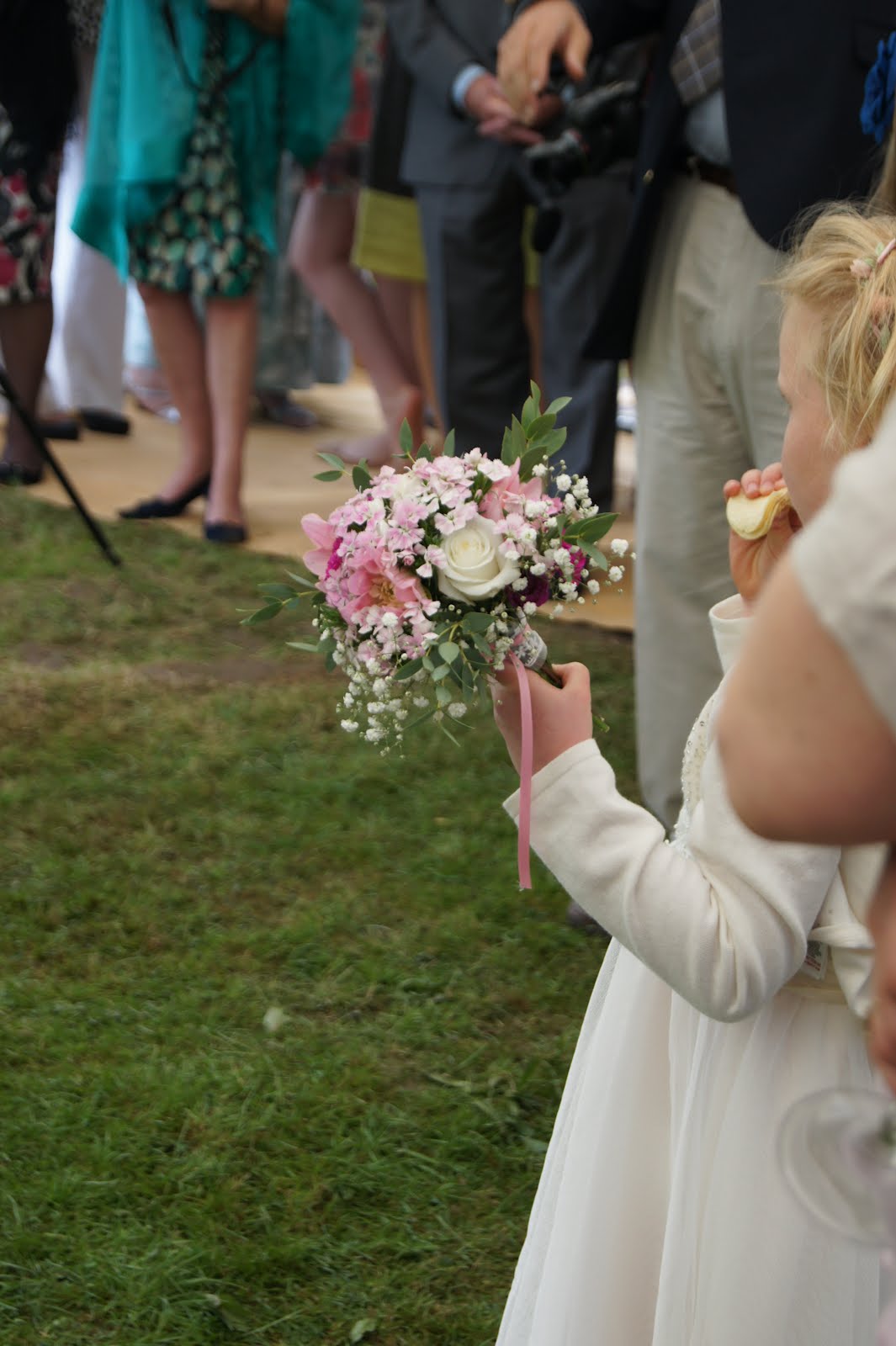
St Maelog’s is a pretty little church nestling in the countryside and it was full to bursting with happy and excited people. Eleanor wore a beautiful classic white dress and her five grown-up bridesmaids wore pretty pink full-length dresses. There were also two young flower girls in white dresses. I made Eleanor’s bouquet with lots of white flowers – phlox, roses, alstroemeria, spiky veronica and gypsophila – contrasted with pink sweet william (particularly delicate and easy on the eye), pink carnations and pink dahlias. Because the bouquet was predominantly white I added in a bit of green eucalyptus to add some contrast with Eleanor’s dress. I put more of the pink flowers into the bridesmaids’ posies so that they would stand out from their dresses and look different to Eleanor’s bouquet. I also added some stronger coloured asters, statice and pink alstroemeria. Most of the flowers were supplied by my English flower wholesaler. Here are some pictures of Eleanor and her bridesmaids looking absolutely lovely:
And here they are setting off from the church after the ceremony:
They were all heading for the hay wain which would take them to the reception. A hay wain is a kind of cart for conveying hay from one place to another and usually it is drawn by a horse. But in this case it was conveying people and it was drawn by a tractor! The hay wain was made comfortable with bales of hay to sit on and it had been decorated with bunting and flowers. Here are the bridal party getting onto the hay wain and then enjoying a glass of champagne as Trevor gets ready to drive the tractor up the road to Cilhowey:
The wedding guests arrived at Cilhowey first of all for a reception of bubbly and wedding cake. Cilhowey sits under rolling hills, and two marquees had been erected on the lawns – a gorgeous green setting. Guests were entertained first with welsh singing (Eleanor’s father, Michael, is the singer in the first picture with the buttonhole), then with French singing:
I was pleased to capture these lovely pictures of Emily (one of the flower girls) who is Eleanor’s niece, her mother Clare (Eleanor’s sister)with her brother Daniel and her father Dave. Daniel and Dave are both sporting their very handsome buttonholes. Clare seems to have picked up Emily’s posy at some stage!
Then here are a few pictures picking out the bridesmaids’ posies and Eleanor’s bouquet:
Later in the evening the guests moved along to the second marquee where the dinner was served. Tables were set up in long lines and Eleanor asked me to decorate them with jam jars filled with flowers. I painted the jam jars with a pretty pattern and tied them with string. Readers of my blog may remember that I developed this design in France last year – it seemed just right for the country wedding style and very fitting that the painted jam jar idea was born in France! I filled the jars with a mix of the same flowers that I used in the bouquet and the posies but added lots of flowers and foliage from our garden – mainly scabious, snapdragons, astrantia, box and rosemary. Here is a sample of the jam jars:
Then here is how they looked set up on one table:
The tables had all been given the names of French and Welsh cheeses (so guests could find their seats), for example Caerphilly and Roquefort:
It was a really big marquee and I made 26 flower filled jam jars! This picture tries to give a sense of how the whole marquee looked:
Finally, the main point of a wedding is to celebrate the glorious union of one woman with one man, and in the process they are surrounded by other attractive (and maybe marriageable!) young men and women. So, boys will be boys:
And girls will be beautiful!

Thursday, 20 September 2012

Lisa's Wedding

It’s been an exciting summer for Meadowsweet. I`ve arranged the flowers for two beautiful weddings – Lisa’s and Eleanor’s. Both have been lovely occasions which I felt privileged to be part of……and I have learnt such a lot. Readers please bear with me as I am going to show you lots and lots of pictures. I will start with Lisa and Simon’s wedding which happened first – at the end of June. This first picture is of Lisa’s bouquet. She chose a white and blue colour scheme. I made it with gorgeous white bridal gladioli (the flowers that spike up from the bouquet), white stocks, white phlox and white roses. Then I added the blue contrast with veronica (the other spikey flower), agapanthus and cornflowers. Then I finished off the edge with some white gypsophila to give the whole bouquet a sense of lightness. The bridal bouquet really needs to stand out from the bridesmaid’s posies. I did this through shape and colour. You can see an example of one of the bridesmaid's posies below. It is made from roses, veronica, phlox and gypsophila so that it ties in with Lisa’s bouquet but then I have added dusky pink astrantia and pink dahlias to provide contrast.
There were four bridesmaids and the picture below shows Lisa’s bouquet and all the posies lined up on a shelf just before I handed them over. If you look carefully you will see that I have finished them off with lace and ribbon at the point where the stems are held together. Lisa’s bouquet stands out from the posies with its elegance and elongated shape. I used English flowers as far as possible in making the bouquet and the posies – the agapanthus, bridal gladioli, astrantia, cornflowers and pink dahlias were all from my English flower wholesaler and these were the stars of the show, giving the flowers a really fresh and unusual look.
The first flower job at a wedding is to meet up with all the men (the groom, best man and ushers) because they get to the church first and need their buttonholes pinned on. You also have to track down the father of the bride and any other important men on the bride’s side who need buttonholes. Simon wanted really simple buttonholes like a mini posy, just made out of one small white flower. I used gypsophila and tied it up with lace and string – this gave a lovely, light country feel. I was pleased that I had made such light buttonholes as the younger men had very narrow lapels and I don`t think they would have held a weighty single flower buttonhole. Here I am – the florist on the way to the bar to pin on the buttonholes!
Lisa and Simon were married at the Holy Trinity Church in Cookham which is not far from Henley. It is an old church believed to date back 1000 years and it is easy on the eye with its attractive stone and the simplicity of its form. The wedding took place on a warm, sunny day in late June and Lisa and the bridesmaids looked lovely – with their flowers adding to the colour and radiance of it all. Here are a few pictures of Lisa and the bridesmaids:
The men also looked sharp and sexy with their little white buttonholes:
And here are Lisa and Simon being driven away from the church in a classic car. I was pleased to get a glimpse through the window of Lisa with her bouquet as they set off to the reception.
The reception dinner was held at Ye Olde Bell, an old coaching inn in a small village called Hurley. This dates back to 1135 – it is a quirky, interesting building with pretty gardens and special areas for private gatherings. One of these is a characterful beamed tithe barn - this is where the dinner was held. Lisa and Simon wanted the barn to have a natural and unpretentious feel – with flowers being placed on the tables looking a bit like wild flowers in a jam jar. I achieved this by using 1 litre kilner jars that have an authentic, traditional look and are big enough not to be swamped by the size of the table. I filled these with English flowers – using the same flowers as in the bouquet and posies and also adding blue ageratum, white and pink alstroemeria, blue statice and mini suwari statice (pink) from my wholesaler. I also supplemented the jars with flowers from our garden – snapdragons, scabious, cornflowers, cosmos, ammi, alchemilla and valerian. I also added some foliage - pittosporum, box and ruscus to provide green contrast. Finally the jars were finished off with ribbon that matched the ribbon used in the place settings and in the bouquet and posies. All the jars were a bit different, but with a common feel to them all. Here are a few examples:
Here is how they looked in relation to everything else on the table:
There were 12 tables in the barn and this picture tries to give a feel of how the whole room looked:
Finally, Lisa and Simon asked me to decorate their ‘cheese cake’. This was made up of layers of round cheeses placed on top of each other. Again, they wanted a natural look. I made little mini posies of box, lavender, rosemary and parsley (all from our garden) tied with lace and string (to match the men’s buttonholes). Then I added a few fresh strawberries and blueberries….it all looked good enough to eat!
At the end of the evening the kilner jars were given away to wedding guests to take home….What a lovely touch to end a perfect day.

Monday, 28 May 2012

Blossoming, Blooming, Burgeoning Spring

I am writing this in May – just as the last tulips and bluebells finish and the cosmos (white and pink) are starting to flower. It has been a strange Spring with days as hot as July in March followed by bitterly cold weather all through April and most of May. But just look at this gorgeous bleeding heart (dicentra) that is growing in our front garden. It seems to really like the place it has settled into. Such pretty, fairy-tale flowers. And here they are in a Kilner Jar together with tulips, veronica, delphiniums, alstroemeria and stocks (some of it from the flower market in Sheffield).
Our garden has produced some wonderful flowers through the Spring – bluebells (both sorts – English and Spanish), daffodils, tulips (a fantastic range of colours – pink, deep purple, bright orange, white and red), snakes head fritillary, gorgeous vibernum (the blossoms start off lime and then turn into frothy white balls), berberis (with little pink, delicate flowers), camellia, sweet rocket and self-set aquilegia. Here is just a small taste of it:
In April we visited a new antique shop in Sheffield with our friends Angela and Ianthe who were staying with us. I found a lovely rose bowl made out of ‘vaseline glass’. This is a really pretty green colour and it is called ‘vaseline glass’ because it looks like petroleum jelly. It is made by adding uranium to the glass! It probably dates from the early part of the twentieth century. It has a removable grid on the top (I think it’s very attractive) to hold the flowers in place. Here is my first attempt at making an arrangement in it – everything was picked from the garden on a lovely day in late April.
I have been making a few commissioned bouquets over the last few weeks. I used English flowers from my wholesaler. The lilies were especially gorgeous – a dusky pink and without an over-powering smell. I also really liked the narcissi, the pink tulips and the anemones. I used similar flowers for my stall at the Nether Edge Farmers’ Market in March. Here are some examples of what I did with them:
Later this year I am arranging the flowers for a couple of weddings – for Jessie’s friend Lisa and for Mike’s god-daughter Eleanor. I will be doing table arrangements, bouquets and button - holes. This made me think about how to gear up to make multiple arrangements (for up to 14 tables say). One idea I had was to use the pretty jugs produced by the Heron Cross Pottery in Stoke-on-Trent. I love this business. The pottery was built in 1876 and has operated since then apart for a period during the Second World War when it was requisitioned for storage. It is still a family run business and the pottery is made in the traditional way in a bottle kiln. The products are really pretty with a great range of chintzy patterns which suit the country look of my flowers very well. I bought half a dozen jugs in two different colours and patterns – this gives a flavour of what they might look like when several are used together.
I sold some of my flowers in these jugs at the Farmers’ Market – people really seemed to like them and I will be selling them again at the next market in June. I am also building up a collection of vintage jugs and vases. These would create a different sort of feel – more quirky and eclectic. As I am moving into events now, I thought it would be a good idea to get hold of a pair of large vases with a narrow neck. My idea was to make really big arrangements for a church or a venue without floral foam. In practice I found it very hard to find anything that met my requirements. In the end I had a couple of vases made for me by the Brook Street Pottery in Hay-On-Wye. They are about 14 inches high and made out of terracotta with a pale sandy coloured slip on the outside. I have only just started to experiment with them. Here is the pair filled with simple plum blossom, and one with an arrangement in it. I will be doing more with these later in the year.
Mike and I have just finished planting out new flowers for the summer. We have grown lots of things from seed – sunflowers, corn flowers, ammi, sweet peas, scabious, bells of Ireland, antirrhinums, cosmos and meadowsweet. We have also bought some perennial plants – veronica, astrantia, phlox, delphiniums, lady’s mantle (alchemilla), baby's breath (gypsophila), verbena and echinacea. So there is lots to look forward to over the coming months – both seeing these flowers develop and working on ideas for wedding flowers. I will be back again soon with summer flower news from Sheffield.

Thursday, 8 March 2012

Cold days and a sniff of spring


The dark days of winter are not the best of times for working with flowers. But they have given me some time for experimenting, especially for finding ways of arranging flowers without floral foam. This first arrangement has been made using chicken wire to hold the flowers in place. I was pleased with the way it worked. The flowers stayed in position really well and there were some advantages over foam – it was easy to take out a flower and re-arrange it (this isn`t a good idea with foam as too much re-arranging makes the foam disintegrate) and the flowers have access to far more water which means they last longer than they would in foam. I used bought flowers supplemented with foliage from our garden – juniper, eucalyptus, fatsia leaves and ivy – placed in an urn I acquired from my father’s house to make the arrangement. The urn is quite an ugly thing, but I think it has a kind of majesty.

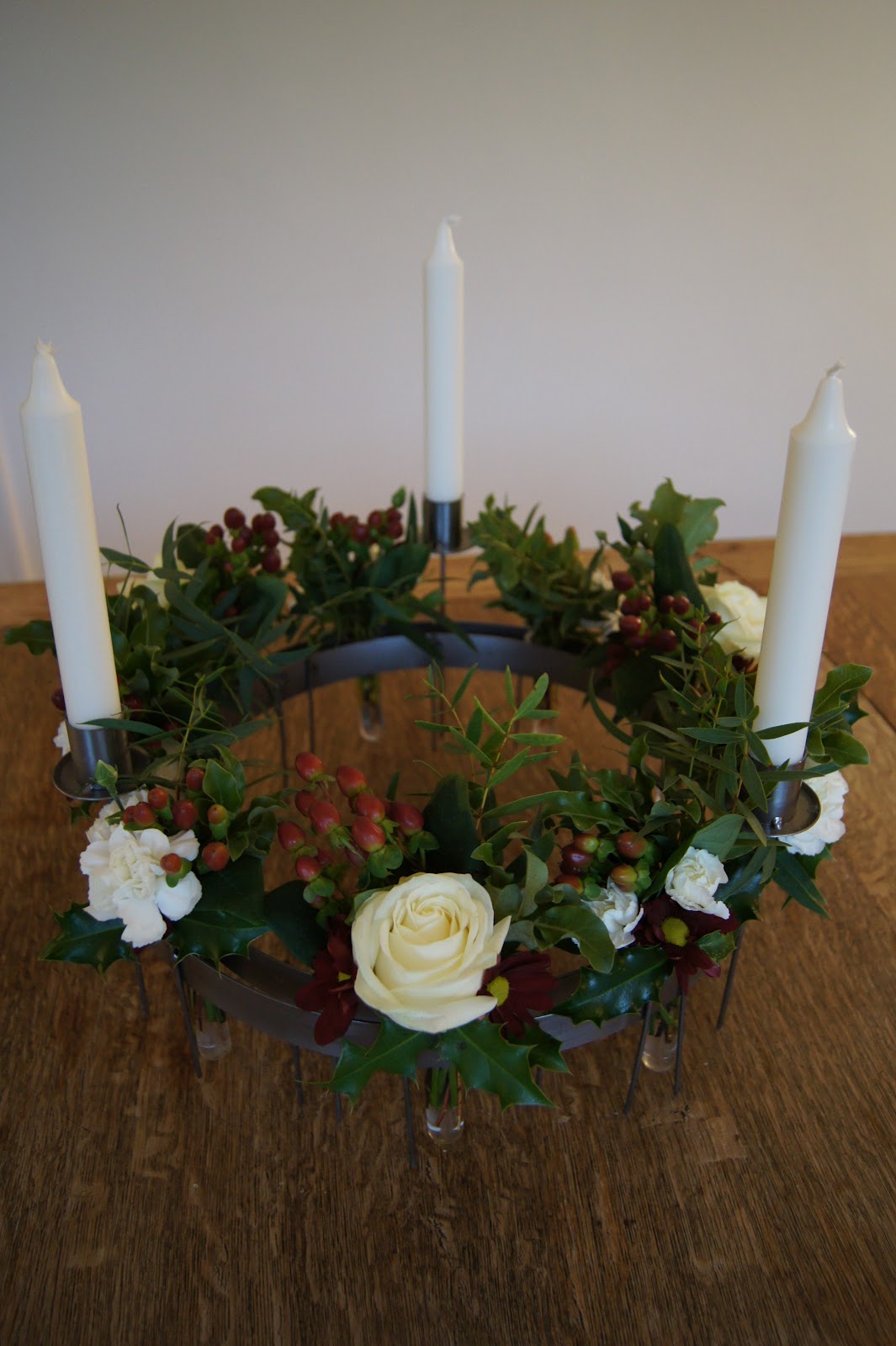
Look at this ingenious idea for making my second experiment - a wreath shape without floral foam.


The flower design involved making little bunches of flowers and foliage that were placed in test tubes held in place in two concentric circles of metal. I used winter colours – white roses and carnations with deep burgundy chrysanthemums and hypericum berries. This made an attractive and quite dramatic table centre. The test tubes needed re-filling every day – but the flowers lasted well for at least a week.

Although we had some frosts in January, we had some gorgeous bright days too. There were a few flowering survivors from 2011 that lasted well into January, like these roses, pinks, antirrhinums and geraniums.


One of the best things we have in our garden in winter is sarcococca (also known as Christmas box). This is a wonderful shrub with deep green leaves and little white flowers which appear in January and February. They smell wonderful and really brighten up the winter.


Here is an arrangement using the sarcococca along with other foliage from our garden and some bought tulips, alstroemeria and roses. When buying flowers through the winter I have chosen English or fair trade flowers wherever possible. I used this vintage blue jug (I am building up my collection of vintage containers) which I think has a pleasing shape and colour.


As we moved into February, the first signs of spring began to appear. We have two sorts of crocus in our garden at the moment, a beautiful camellia, a robust hellebore, lovely primula (yellow and purple) and the daffodils started to appear at the end of February. Here is a flavour of it all:


Mike has been germinating seeds for me over the last month – different colours of scabious, corn flowers, cosmos (white and pink), small sunflowers, meadowsweet, white antirrhinums, ammi and moluccella (bells of Ireland). I hope these do well and that I will be making arrangements with them in the summer.

Lots and lots to look forward to in the coming months.