Tuesday, 25 June 2013

Late Spring in Sheffield and on Salt Spring Island


What a fantastic late spring it has been for glorious native flowers (from both England and Canada). In late May I had a commission to design flowers for an 80th birthday celebration at the Beauchief Hotel which is just a mile from our house in Sheffield. The picture above shows the table centres ready to go. I made them in jam jars decorated with pretty vintage paper and dusky-coloured ribbon. Most of the flowers were English – some from my wholesaler in Cornwall and some from our garden – soloman’s seal, bleeding heart, bluebells, alstroemeria, iris, ammi and our first astrantia. I had also been asked to make a small cake decoration mainly with small red roses. So, to tie everything together I added a few white and red roses to the jam jars. It all looked really lovely – vibrant and full of colour. Here are a few pictures of the flowers running along the length of the table on a bright sunny day in late May.


And here is the little cake arrangement – I have used the same paper and ribbon to decorate the jar and to give the whole design a feeling of cohesion.


I ran a workshop in May using a traditional method of arranging flowers as an alternative to using floral foam. Regular readers of my blog will know that I have rejected using floral foam (oasis) in my arrangements because it is harmful to the environment (not biodegradable), potentially harmful to human beings (some of the ingredients may be carcinogenic) and it is just not a very nice medium. So what is the alternative? Well, before floral foam was invented, flower arrangers used crunched up chicken wire to hold the flowers in place and this is what we did. Here are the raw ingredients for the workshop – blue bells with plastic bowls, gloves (to protect hands) and chicken wire, and a bucket filled with fragrant spikes of stock, dramatic stems of soloman’s seal, blue iris, pink alstroemeria, bluebells and pure white avalanche roses (the only non-English flower in the arrangement). Then we used 3 sorts of foliage – aspidistra leaves, ruscus and a small-leaved laurel.


We covered the plastic bowl with aspidistra leaves and finished it off with candy pink raffia. Then we constructed a wonderful round arrangement which looked like this.


The arrangements were simply spectacular. Here are the participants looking very pleased with their creations, and also a picture of me looking pretty pleased with myself as well. What a great morning it was and what gorgeous flowers for adorning our homes over the May Bank Holiday weekend.


Then a few days later Mike and I went on holiday to Canada. We went on a house swap holiday to Salt Spring Island which is situated between Vancouver and Vancouver Island. It has a mild climate and there are lots of small farmers on the island – the main way they sell their wares is on farm stands placed at the side of the road. Typically the items for sale are displayed on the stand and people pay by placing their money in an honesty box. Here is an example of a stand selling vegetables to grow.


Most of the farmers sold a few cut flowers, but the best stand of all was just a few hundred yards from our house. The farmer was a sparky, friendly woman who won a prize for being the most innovative farmer on the island last year. She sold a fantastic mix of colourful flowers for just 3 Canadian dollars each (about £2). Here she is with me and here is an example of how she displayed some of her bouquets on a fence. Notice the newspaper cones she has made so that people can carry their bouquets away easily and not get wet. What a great idea! 


I wondered how she could possibly make a profit on these prices. She told me that she sold 350 bouquets a month (that's a lot). She will have virtually no overheads, probably gathers her own seeds and almost certainly doesn`t cost up all of her labour. So she does make a basic living out of this, but I think the flowers are far too cheap when you consider how beautiful they are and what is involved in growing them, cutting them and displaying them. Aha…typical under-valuing of female endeavour (more of this another day/blog). I bought one of the bouquets and arranged the flowers in a vase – all of the flowers and foliage are also found in England (though a bit later in the year); foxglove, rose, lavender, mint, rosemary, marguerites, cosmos, thermopsis (with yellow pea-like flowers), lysimachia punctata , choiysia and laurel.


Then here is another flower farmer who sells her produce at the weekly farmers market. Her prices are higher (bouquets at 10 dollars, 15 dollars and 20 dollars) – but still astounding value. I bought one of the 10 dollar bouquets (about £6) which was made up of an abundant mix of purple and pink flowers – lupins, campanula, stachys, wild phlox, astrantia and alchemilla mollis.


These locally grown flowers are so much lovelier than standard supermarket flowers that have been flown in from as far away as Kenya (in the case of the UK) or Columbia or Ecuador (in the case of Canada). They have been grown with far less use of pesticides and fungicides and the ‘flower miles’ are negligible. It was a fitting coincidence that just when I was pondering these matters New Covent Garden Market ran a British Flowers Week. This ran all of last week (17-21 June) and it featured British flowers (sweet peas, delphiniums, stocks, peonies and foliage) arranged by celebrity British florists including Vic Brotherton of  Scarlet and Violet whose work I admire. In addition, florists from across the UK were invited to send in photographs of their own work. I sent in quite a lot of pictures and they were all put up on the gallery. If you go to http://www.newcoventgardenmarket.com/galleries  and click on Part 1 you will see my pictures. I was particularly pleased that one of my designs was selected as the front page of the part 1 set of images. This is a photograph that I have shown before in my blog, but I will end by showing it again. It features a range of English narcissi, green iris and eucalyptus and it was constructed using the same method as we used in the workshop I have described here. I felt the sweet glow of success!


Monday, 29 April 2013

April Workshops


This is the bouquet which we made at my April workshops last week. I ran the same workshop twice - once on Thursday evening and again on Friday morning. We used an exuberant mix of English spring flowers shown off in a lovely Heron Cross jug. Here is the room set up with the delicate spring flowers – tulips, bluebells and narcissi (Silver Chimes) in Kilner jars. They looked and smelled just lovely, and they encapsulated everything that is hopeful about Spring.


And next you can see the alstroemeria, the fantastic solomon’s seal and the foliage (myrtle and eucalyptus) in buckets waiting to go….and also 3 different colours of hyacinth. Participants could choose their colour of hyacinth and also choose the colour/pattern of their jug. The final ingredient was this lovely acid green hellebore from our garden.


We used hand-tying techniques in the workshop. We started off making a small posy (using tulips, bluebells, hellebore, narcissi and foliage) so that everyone could practice the technique before we got onto the main act. Here is an example of a finished posy…..very, very pretty.


Then here are a couple of examples of completed bouquets – one in a pink jug with a violet hyacinth at the centre, and the other in a blue jug with a blue hyacinth (oh..and there's a celebratory glass of wine as well!).


Then here are some pictures of participants looking very happy with their finished arrangements. They deserve to look pleased with themselves as they all managed the hand-tying process really well and took home some gorgeous bouquets and posies.


I used the flowers left over from the workshops to make an arrangement in this Chinese vase which I bought in a Sheffield antique market a year ago. It is a beautiful vase with an exquisite pattern of flowers and butterflies. I have two the same and am planning to experiment more with them this year – I think they would look lovely at a spring or summer wedding.


At the beginning of his poem The Waste Land, T S Eliot wrote:

‘April in the cruellest month, breeding
Lilacs out of the dead land, mixing
Memory and desire, stirring
Dull roots with spring rain.’

This really captures my mood at the moment. I so want the lilacs, the bleeding hearts, the bluebells, the aquilegia and the roses to all get going. Everything seems slow and dull this year, but, at last, it is beginning to stir. Here are a few pictures of the flowers that are growing in our garden now – hellebore, hyacinths, tulips, euphorbia and, best of all, snakeshead fritillary. We have just started planting out ammi and snapdragons that we have grown from seed, and the cosmos and scabious are not far behind….lots to look forward to.


Thursday, 28 March 2013

Early spring (!) flower workshop


This is the view down our road last Saturday morning, a weekend in late March, when everyone was due to arrive for the first of my spring flower workshops. It had snowed for 24 hours solidly and it was still snowing. The only way up and down the road was in a 4 by 4 or on foot with walking boots! Then here is is the view outside our back door – just look at the poor, frozen daffodils!


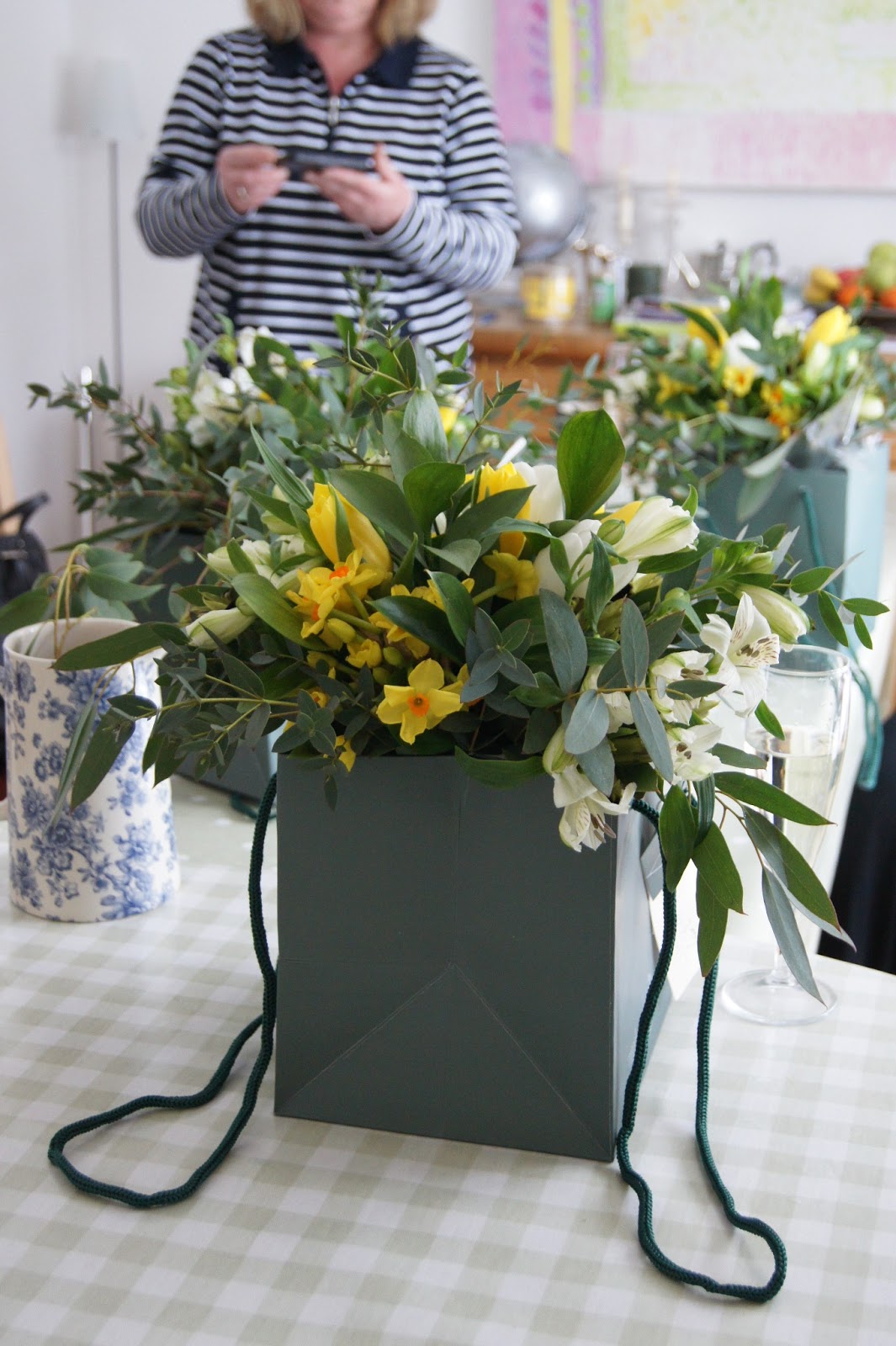
Luckily, most of the participants were able to come on the Sunday instead so we were able to go ahead with the workshop. Planning it had been a bit of a challenge as there were so few English flowers available from my wholesaler – no anemones, no alstroemeria, no lilies, no ranunculus, no yellow iris and no bluebells. All of these had been available this time last year when we were experiencing an unseasonable heatwave! This shows the challenge of planning events using English flowers which are so sensitive to our variable weather. I was able to buy scented narcissi – both yellow (golden dawn) and white (avalanche), yellow and white tulips, green irises (intriguing – I had never seen these before) and two different sorts of eucalyptus. I designed a grouped bouquet using just yellow, white and green. I made a visit to the Sheffield flower market to buy some gorgeous, pure white alstroemeria (though they weren`t fully open by Sunday despite keeping them in a warm room) and also some additional foliage to add a bit of contrast with the eucalyptus. Here is the room set up for everyone and a close up of the flowers ready to go. The green irises were quite exquisite in a subtle kind of way.

 
We used the tulips for the centre of the bouquet, but I suggested that everyone keep them low in the centre and place the foliage an inch or so higher than the tulip heads. This was to give them space to grow – this is because the pesky things grow several inches in height when you put them in water. Also, placing them in the centre meant that they were held straight by the other flowers. Thinking about this kind of thing is important when you consider the lifetime of the bouquet – you want it to look lovely when you make it, but you also want it to look good several days later when it is standing in a vase on your sideboard. We made two of the surrounding posies with the narcissi densely grouped – one of white and one of yellow. Then we made the other two posies out of a mix of alstroemeria and green irises. I decided to do this because the irises were too small to stand alone as a group. The dark brown-purple of the iris worked well with the dark flecks in the alstroemeria. Here is the finished bouquet and participants taking photos of their creations (it is difficult to see the irises in photographs as they blend in with the foliage).


The participants were interested in other ideas for working with flowers and I showed them some of the books that have influenced me. Here they are – people and books.


We had some discussion about the need to select a jug or vase which is the right shape, size and colour for a bouquet. I decided to use this unusual light green jug that I picked up from an antique market last year. You can see how the bouquet looks different from different sides. I took these photos a couple of days after the workshop - the tulips had grown quite a lot and the alstroemeria had opened up. As the days progress the narcissi groupings will die before the other flowers. One advantage of the grouped bouquet is that it can be taken apart when this happens so that you are left with a few small posies to enjoy in smaller vases.


I had quite a few flowers left over as one participant hadn`t been able to make it to the workshop in the bad weather. So I decided to make an arrangement using chicken wire. This works as an alternative to oasis (floral foam). Readers of my blog may remember that I don`t use oasis in my flower work because I don`t like it, it isn`t biodegradable and it contains substances that may be carcinogenic. Chicken wire is an old way of holding flowers in place and it works very well. It also has the advantage that you can take flowers out of the arrangement and replace them at any time – this isn`t possible with oasis as it crumbles and disintegrates. Furthermore, flowers (especially spring flowers) last far longer in water than they do in oasis. Case made! Here is a spring arrangement which would work well as a table centre.


I also experimented with another method of holding flowers in position with this simple arrangement. The flowers and foliage are held in place by making a grid out of tape over the top of the container. The double daffodils are called golden ducket – they are large, bright and something to smile at during these wintery cold days. Roll on spring!

Thursday, 28 February 2013

February Wedding Fayre


 February is a difficult months for flowers – the supply of English flowers is limited (though lovely) and people aren`t really ready to think about flowers when snow and ice are still lying on the ground. But I`ve been motivated to do a lot this month as I was working up to my first wedding fayre which took place last weekend. This is an event marketed to potential brides where all kinds of suppliers, from vintage cars to bespoke wedding gowns, show off their wares. I was allocated a table to sell ‘Meadowsweet’ and I wanted to show what I could do with fresh English flowers and foliage in February. I decided to use reds, yellow and orange for one set of arrangements (red anemones, orange alstroemeria, yellow narcissi and a few white narcissi). I made a couple of arrangements in Heron Cross jugs and three small arrangements in vintage cups and saucers (especially pretty I think).


Then I made a second set of arrangements in a different range of colours – blue and pinks, with quite a lot of white (blue anemones, pink alstroemeria, pink tulips and white narcissi). Again, I used a couple of Heron Cross jugs. Then I decorated jam jars in lovely vintage paper that I found in Hay-on-Wye and pretty blue-grey ribbon for the three small arrangements.


In preparation for the fayre Jessie had made postcards for me to promote my products – weddings, workshops and bouquets. She also designed a portfolio for me to show case weddings and associated products. I set up my table with the arrangements I had made and the postcards, and I placed a slide show of wedding pictures in the middle (this ran all the time on my computer – hopefully to catch people’s eyes). Then I had the portfolio ready to show to people.


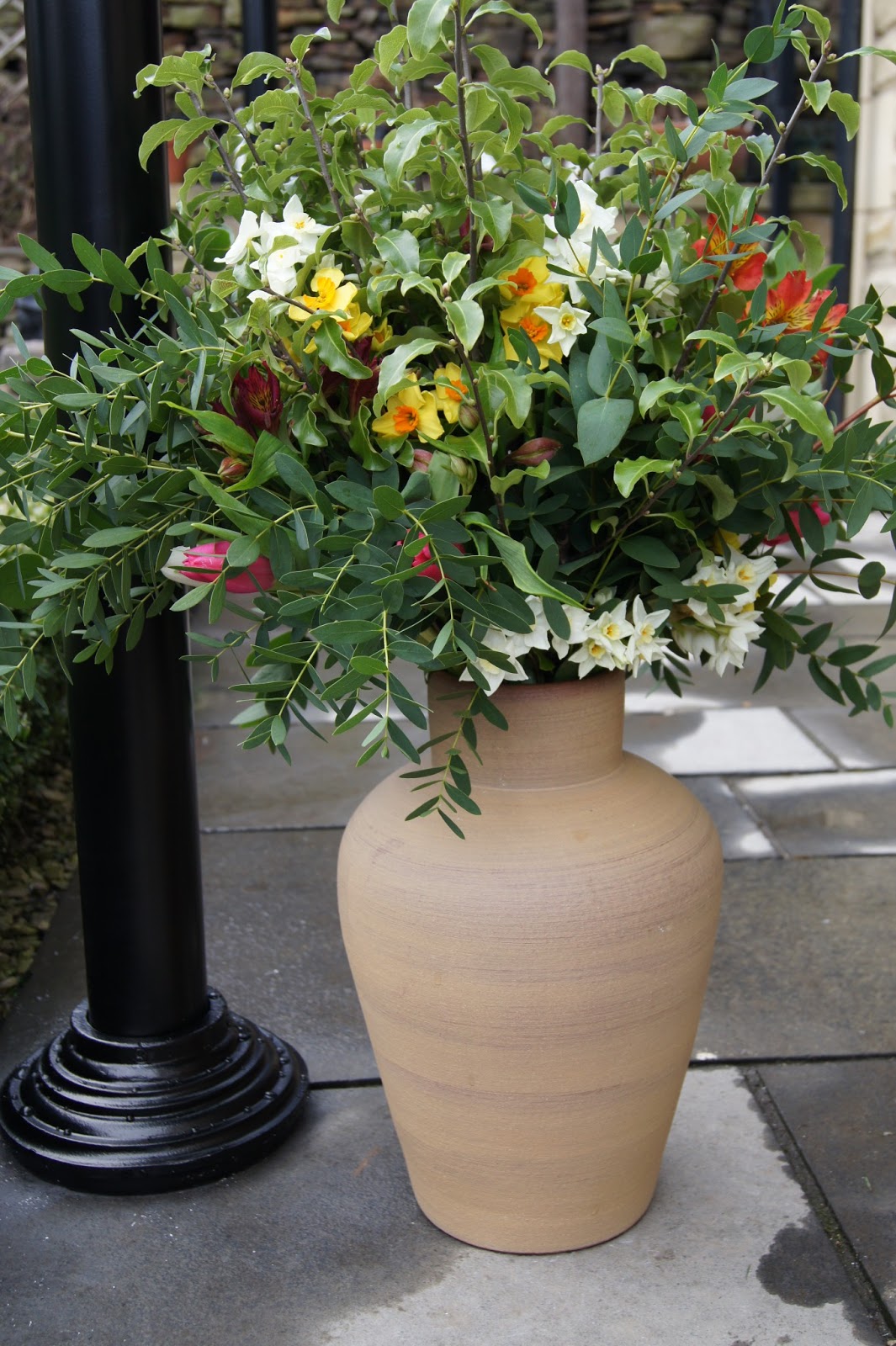
There was a steady trickle of interest (though not a rush) and I gave away a lot of wedding postcards….I will have to wait and see if any convert into real interest. I was really pleased to get one definite booking to make jam jar table arrangements for a special birthday celebration in May. I was also pleased to make contact with one or two other suppliers whose services are complementary to mine – in particular the gorgeous vintage wedding stationery produced by Claryce Design and the splendid vintage volkswagens supplied by Vintage VolksWeddings. It was also good to catch up with an old friend who did the same floristry course as me and who is now working with a professional florist. After the wedding fayre I used up my surplus flowers and foliage to make a couple of simple arrangements in some of my large vessels. Here they are next to our new veranda!


A couple of weeks ago Jessie and I visited the Garden Museum in London (some interesting stuff and a peaceful location in an old church). I noticed some inspired, but uncomplicated use of daffodils in a large urn just outside the museum. It gave me the idea to make this simple arrangement in a small urn. Next week I am visiting my friend Judith in Oxford and we are going to a lecture by the Director of the Garden Museum. His talk has the title: ‘Floriculture: flowers, love and money’ and it is based on the exhibition about the history of the cut flower trade in Britain which has just opened. I will be interested to see what sources he is drawing on as I am finding the floristry industry pretty difficult to research as so little has been written about it…more about this later. I am working up to writing something myself.