Tuesday, 27 May 2014

Celebrating May

May has been a great month for working with flowers partly because of the bright, colourful spring flowers available, but also because I had a new space in which to do all my preparation. During the winter we painted the walls of our garage white, painted the floor grey and let in some natural light. The picture above shows the lovely light quality we have created. I ran 3 workshops in May. First of all, two back- to-back workshops to make 3 hand-tied posies in jam jars decorated with pretty vintage paper. Here are some of the jam jars:

 Here are the flowers ready to go in my new garage space:

The first thing is to get the flowers lined up in the right order for tying.

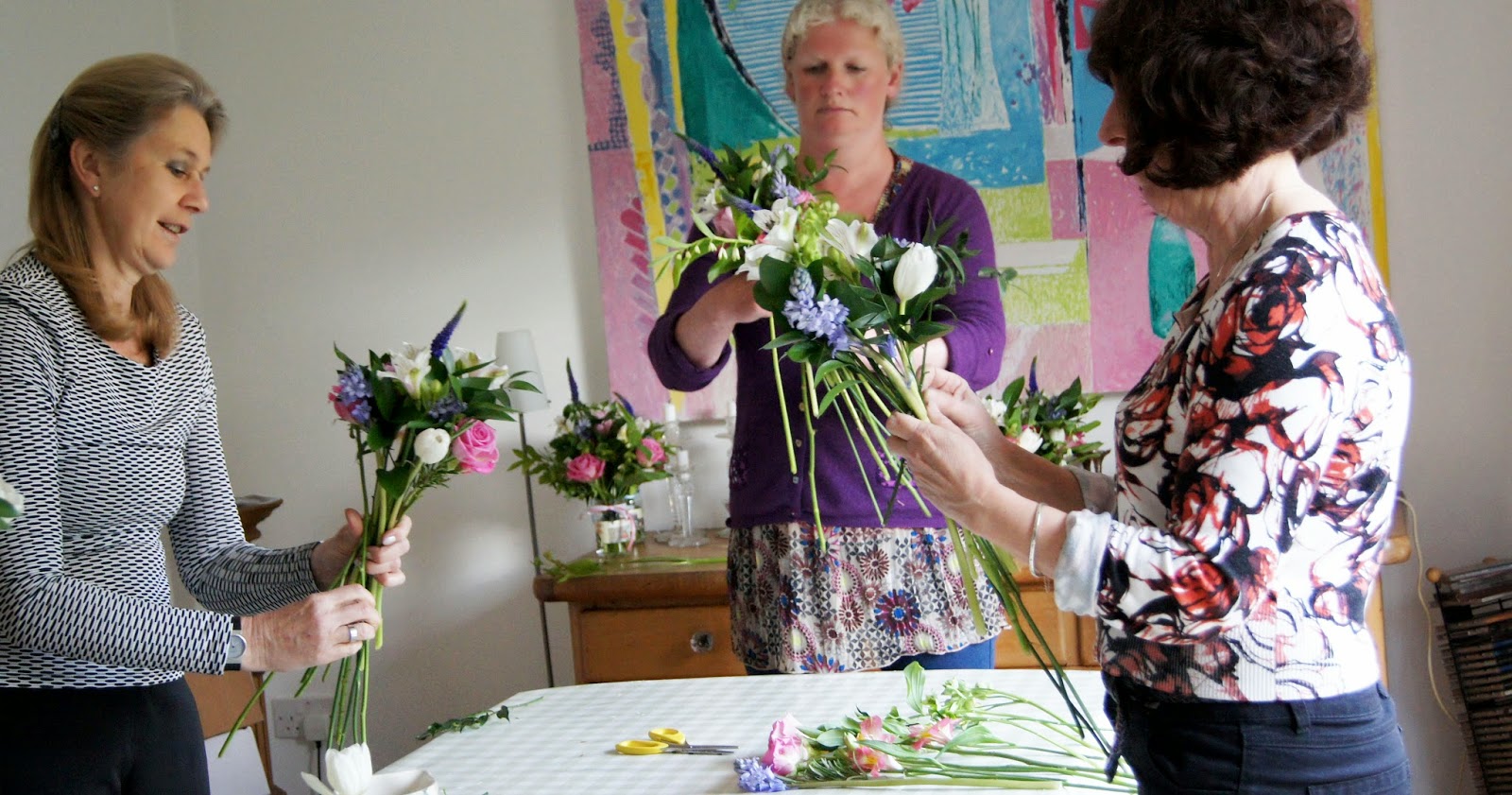
 I was really pleased to get quite a few action pictures. If you look carefully you will see lots of examples of wonderful spiralling of the flower and foliage stems. This is the main challenge of hand-tying, and as one the participants suddenly said ‘by Jove she’s got it’……and they all did.

Here is the finished product:

And here are the boxes that I made out of the large boxes that my flowers from Cornwall were delivered in. These worked very well for carrying the posies home and it felt good to do some active re-cycling.

Then this last weekend I ran another workshop to make a large, exuberant arrangement in chicken wire and I got some more action photos. We used wonderful bright yellow snap dragons and stocks in a range of pinks/violets as the main flowers.

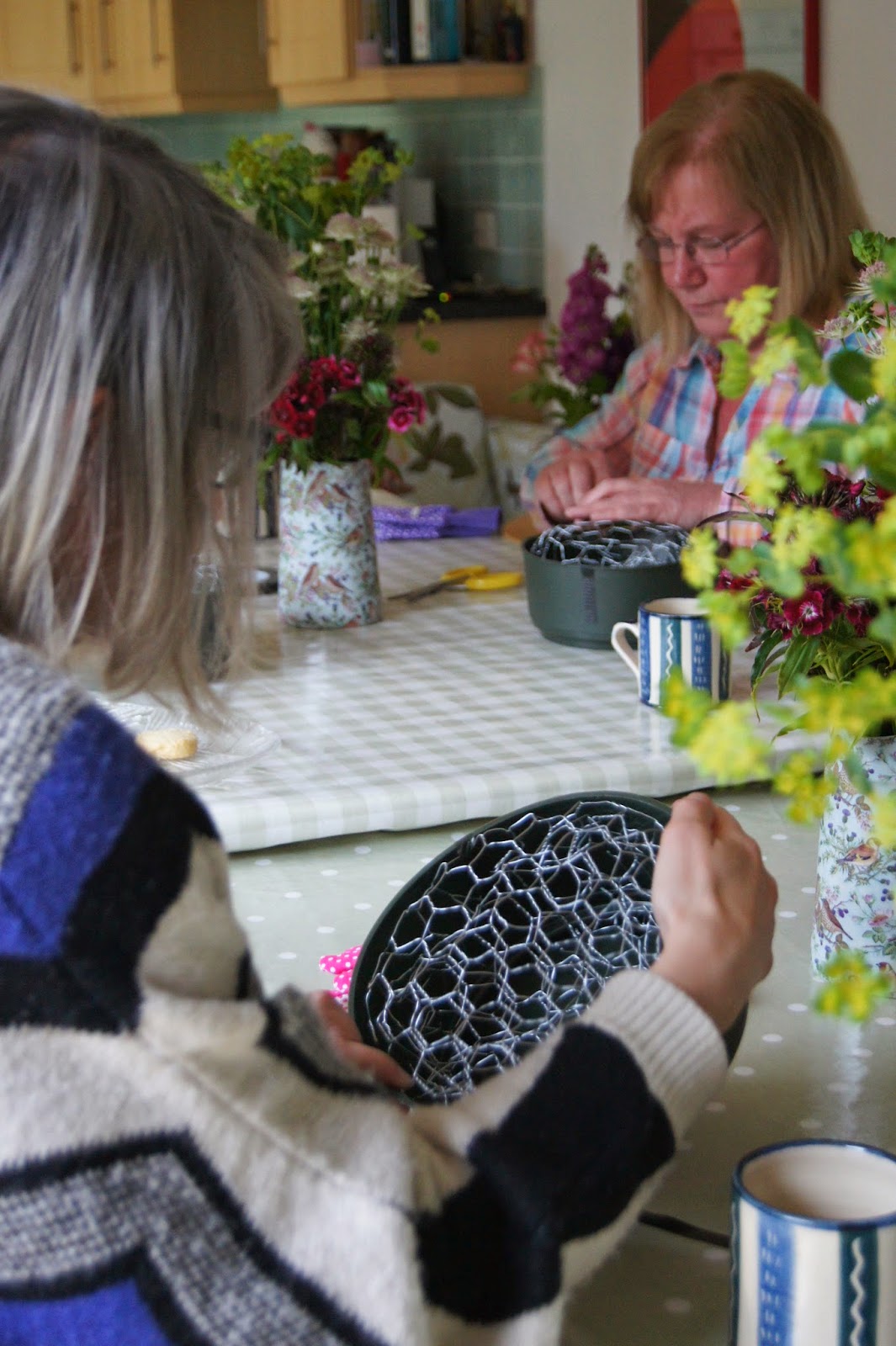
First everyone fixed the chicken wire in the bowls and decorated the bowls with aspidistra leaves and raffia.

Then they made the central part of the arrangement.

 Then they added in alstroemeria, astrantia, sweet william and pinks.

Here is the final outcome. Stunning.

This weekend was the May Bank Holiday, but the weather wasn`t very good so I spent some of it looking around the vintage shops in and around the Abbeydale Road in Sheffield. I was delighted to find a plinth very like one I already have. The two plinths work really well together and would look good in a church or some other large venue.

To finish……let’s raise a glass to celebrate May flowers, good health and the coming summer.


Thursday, 3 April 2014

Mother's Day - a showcase for British flowers

Ranunculus from Cornwall – I put lots of these beautiful, delicate flowers into my Mother’s Day bouquets. Mother’s Day is celebrated all over the world and mostly in the spring. According to Wikipedia, the UK version of the celebration derives from 2 sources. The first is religious, dating back to the 16th century, when mothers were re-united with sons and daughters released from apprenticeships and work in service in order to attend their mother church. The celebration declined with the Industrial Revolution, but was revived after the Second World War by the second source – US soldiers spreading knowledge of the American celebration of their mothers. The religious roots mean that the date of our Mother’s Day is linked to the church calendar and it is always held on the 4th Sunday of Lent – it could be as early as 1 March or as late as 4 April! Like Valentine’s Day, Mother’s Day is a fantastic opportunity for British flower growers, especially as interest in seasonal British flowers is expanding. My Cornish wholesaler told me he clocked up record flower sales this year as well as selling 1,200 bunches of Cornish foliage. Just look at the reason why – here are a couple of images of the tulips, ranunculus, white and yellow narcissi (avalanche and soleil d’or), alstroemeria, eucalyptus and pittosporum which made up the raw materials for my bouquets and flower workshop:

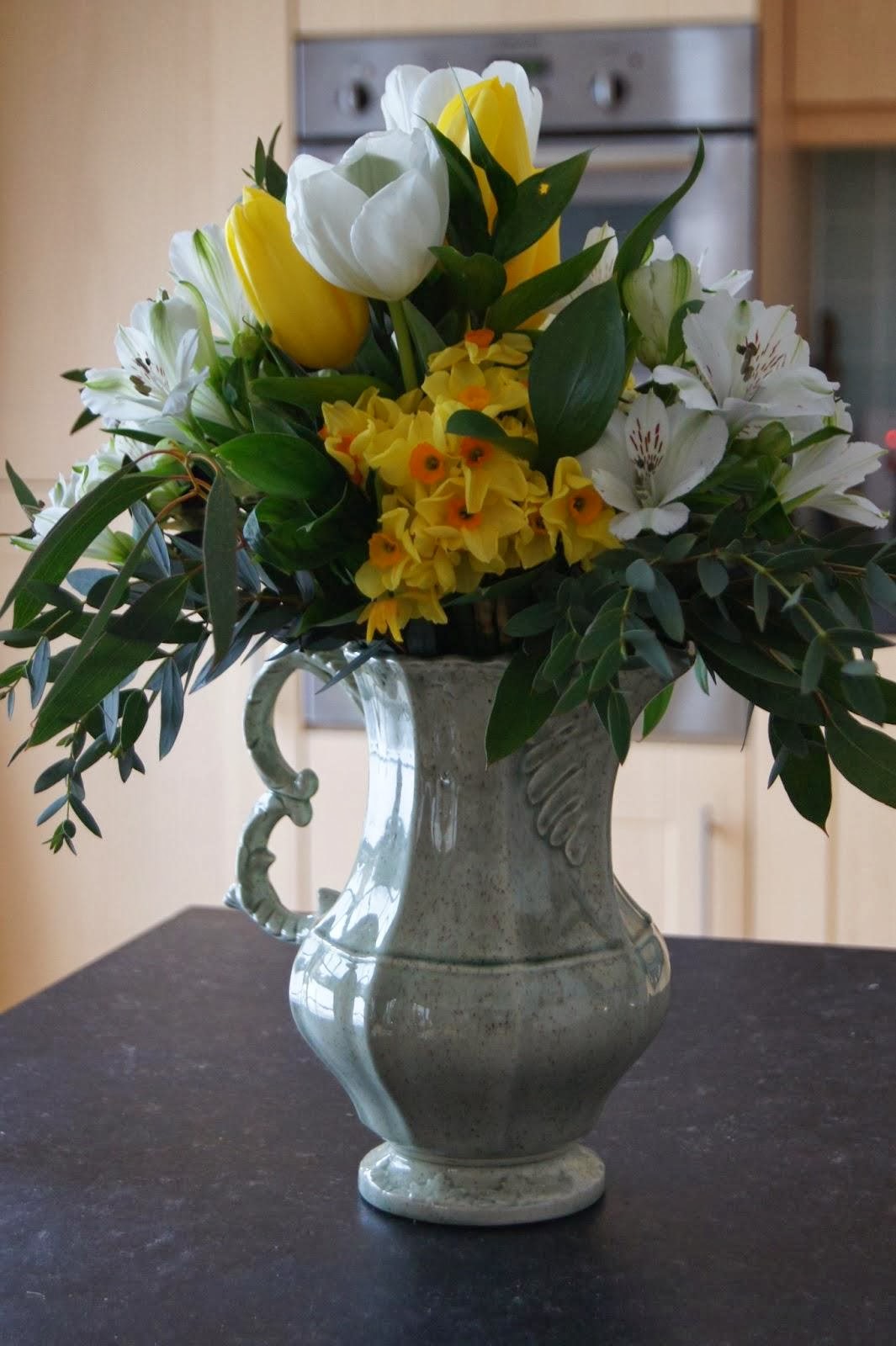
In the workshop we made grouped bouquets which we then placed in pretty Heron Cross jugs. The great thing about these bouquets is that you can look at the bouquet from different angles to see different groupings of flowers. I warned the workshop participants that their tulips would grow several inches in the vase and their bouquets needed to allow space for this. Just look at the growth in the third picture below - at least three inches (picture taken today,  five days after the workshop):

The idea was that participants would give their bouquets to their mothers, but I thought daughters and nieces deserved something pretty too, so we also made small posies in jam jars:

Then we put the jugs into green presentation boxes and everyone took a few photos:

I really like this picture of one of the participants who looks particularly pleased with her creations – and so she should be, they were lovely, and skilfully made.

I will finish this blog with a picture of a humble bunch of daffodils that Mike bought for me yesterday from our local supermarket. I see these as a symbol of optimism for British flower growers. Daffodil is the common name for the genus of flower called narcissus. The wonderful thing about narcissus flowers is that they grow really well in Cornwall, Devon and the Scilly Isles. The flowering season lasts from November to May and this means that they catch four great markets – Christmas, Valentine’s Day, Mother’s Day and Easter. When the Garden Museum ran their exhibition – Floriculture – Flowers, Love and Money last year they presented some interesting facts about the UK narcissus market. The UK is the world’s largest producer of narcissus cut flowers and exports them to many countries including Holland, Germany, Scandinavia and America. The UK also produces half of the world’s narcissus bulbs and exports 10,000 tons of them annually (worth around £7 million). Overall, growing narcissus flowers adds around £23 million to the UK economy. Hurray for our flower growers, the wholesalers who distribute the flowers and the florists and supermarkets who stock them for us to buy. Enjoy your daffodils – the season will soon be over!


Friday, 7 March 2014

A host of golden daffodils...and a leek

I had my first sniff of spring when my flowers for Valentine’s Day were delivered. There were yellow and white narcissi, tulips in all sorts of colours, pink alstroemeria, bright yellow daffodils and anemones – red, white and blue. The picture above shows some of the Valentine’s bouquets ready to go – not the usual florists’ offering of red roses flown in from Holland or Kenya, but British spring flowers and foliage. I made smaller bouquets than usual at a more affordable price (£20). I received great feedback about the flowers (both their freshness and their scent) and here they are closer-up:

Last Saturday was St David’s Day, the feast day of the patron saint of Wales. Mike and I are in Wales this week and we were here on St David’s Day. Lots of people pinned daffodils onto their clothes – daffodils are a symbol of Wales and so are leeks! The daffodils make a lot of sense because they are growing everywhere this week and are a wonderful sign that Spring is here at last. I`m not so sure about the leeks – but I think they are used to make a traditional Welsh soup. We are staying in Hay-on-Wye and I came across this arresting shop window display at Booth’s Bookshop. It included daffodils, a leek and a poem about Spring:

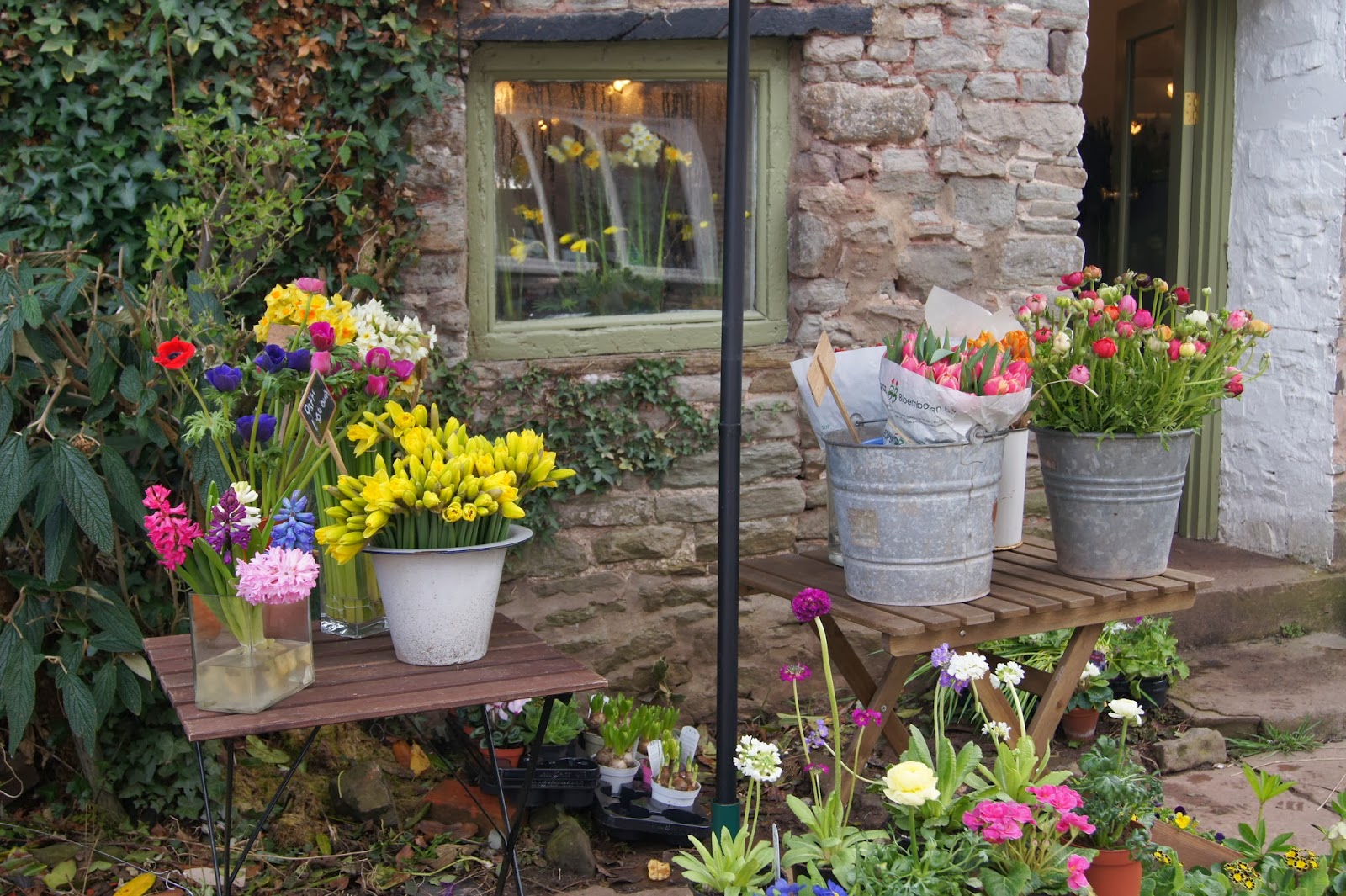
A new flower shop has opened in Hay called Dandelion Wishes. It is in an old building by the castle. It is just the sort of shop I would like if I had a retail space. Just look at the gorgeous narcissi, daffodils, ranunculus and the spring flowers growing in pots. You can also see the Welsh dragon on the flag in the background.

Here is the bunch of daffodils that Mike bought for me, and here is the arrangement I made with them using the foliage and berries I could find around the house.

The arrival of Spring has made me think about flower workshops and flowers for Mother’s Day. If you look on my website you will see new dates for spring workshops (including a workshop for making your own arrangement for your mother on Saturday 29 March) and my offers for Mother’s Day flowers (bouquets at £30 and £20 and posies at £16). I will finish this blog with a picture of a bouquet of grouped flowers in a vase which we made in a workshop about this time last year. We will be making something similar to this in my Mother’s Day workshop later this month (but in a different jug).


Thursday, 23 January 2014

Supermarket flowers: an ethical challenge

Look at these beautiful roses – they were imported from Kenya and I bought them in Sainsbury’s for the first of my workshops based on supermarket flowers. Although I prefer to buy seasonal English flowers, in the winter months the choice becomes very limited and I turn to other sources, including supermarkets. The size of the cut flower and houseplant market in the UK is estimated by Mintel to be about £2.2 billion. It is further estimated that about 70% of UK cut flowers are sold through supermarkets. Research by the Garden Museum suggests that only 10% of all the flowers sold in the UK are grown in the UK – this is down from 50% in the 1980s. The large majority of flowers sold in supermarkets are imported from Holland, Kenya and Columbia. In practice, many of the flowers coming through the Dutch flower market are imported into Holland from developing countries. These bright red alstroemeria were imported from Columbia.

Should we be worried about this? Of course we should. We are in danger of losing our British flower growing industry completely and our high street florists are in serious decline. This is mainly because supermarket flowers are ridiculously cheap. They are cheap because most of them have been grown in developing countries where growing costs are less than in the UK (the climate is hotter and the labour costs are rock bottom low) and also because of the supermarkets’ buying power which drives growers’ prices down. However, there are a number of ethical challenges associated with flowers imported from developing countries. A War on Want Report, ‘The human cost of cut flowers in British supermarkets’, published in 2007 provided evidence of very poor working conditions for flower workers (largely women) in Columbia and Kenya – these included very low pay, exposure to toxic chemicals, repetitive strain injuries, forced labour and job insecurity. Concerns were also raised about the use of huge amounts of water to cultivate flowers at the expense of small-scale farmers growing other crops. These concerns are supported by a number of recent academic papers about the cut flower industry in a range of developing countries. For example:
I am pleased to say that we can all do something about this by buying flowers certified by the Fair Trade Foundation. This is an independent, non-profitmaking organisation which licenses the use of the fair trade mark in accordance with international standards. It states ‘Our vision is of a world in which justice and sustainable development are at the heart of trade structures and practices so that everyone, through their work, can maintain a decent and dignified livelihood and develop their full potential.’ It works to achieve better prices, decent working conditions, local sustainability and fair trade for farmers and workers in the developing world. When flower farmers achieve fair trade certification they commit to implementing better pay and working conditions and to farming in a more sustainable and safer way. When you buy fair trade flowers you pay an extra 10% (the fair trade premium) for your flowers and this goes back to the flower workers for projects to support them and their communities. All the roses pictured here and used in my workshops were sourced from fair trade farms and if you look on the flower packaging it will tell you exactly where the flowers came from. If you then look on Sainsbury’s website you can link up with the Fair Trade Foundation to find out what the fair trade premium (10% of the cost of the flowers) achieved for the flower workers (things like schools, vaccinations, clinics and water purification). For example:
I decided to concentrate on using fair trade roses for my two workshops. First of all we made a contemporary arrangement in small square boxes. I made these by covering juice cartons with pretty vintage paper. For the Christmas workshop I used a Christmassy vintage paper. Here are the boxes.

And here are the arrangements – they work well either spread out (pretty with tea lights set in between the boxes) or pushed together into a block to make an impact.

We also made a simple, but effective arrangement of three roses in a pretty glass bottle. We used Belvoir cordial bottles for this – they have a vintage look about them with the name Belvoir pressed into the glass. These look great if you place three in a row along a window sill or a mantelpiece.

Then we made a wilder arrangement in a glass jug using fair trade roses, alstroemeria and seasonal foliage. Supermarkets sell hardly any foliage (and if they do it is tremendously expensive) so we used foliage gathered from around my house. For the first workshop we used holly, ivy and yew (be careful with yew as it is very poisonous!).

We also used white English alstroemeria from Cornwall (to go with the pink roses). I was delighted to find that Sainsbury’s was selling this when I went flower shopping (though they didn`t have it when I went shopping for the second workshop). Again, the packaging was very informative and provided details of the grower and his farm – the flowers were super fresh and very lovely. Another hit for Sainsbury’s as far as I am concerned. So here is something else we can all do – buy British flowers whenever they are available.

For the second workshop we used the bright red alstroemeria from Columbia with white roses. The foliage was ivy, holly and pine (including few pine cones…..very Christmassy). Here are some pictures from both of the workshops:

And here are some of the workshop participants – all looking very pleased with their beautiful arrangements.

I would like to finish this blog on an up-beat note. There has been a lot of interest in British flowers recently and many people are beginning to see what growing in our own country has to offer. Last spring (2013) the Garden Museum in London ran an exhibition with the title of Floriculture – Flowers, Love and Money. This included ‘a celebration of domestic growers, an industry which has all but vanished but may be revived by a new generation of eco-aware creative growers’. Then New Covent Garden ran a British Flowers Week in June last year – this featured British peonies, delphiniums, sweet peas, stocks and foliage (see my blog of June 2013, including my own contribution to the week). More recently my wholesaler in Cornwall – James at Flowers by Clowance – reported that the current BBC series on the Great British Garden Revival has led to an increase in orders for English flowers. Fantastic. He also told his customers about the Great Flower Farmers’ Meet Up in Devon a couple of weeks ago. 100 British flower growers met together for what sounds like informative sessions about developing businesses, mutual support and a lot of fun. This makes me feel more optimistic about the future of the industry. Finally, as a contrast to the Kenyan roses, here is a picture to remind you of what a spring bouquet made with only English flowers and foliage looks like – soft, fragrant and colourful. Simply lovely.

So, my challenge to you all is to buy British flowers and Fair Trade flowers whenever you can. As consumers we have a lot of power if we act together and we can make a real difference to the lives of flower farmers here in the UK and also around the world.

Sunday, 1 December 2013

Christmas flowers: bouquets and workshops

As December begins everyone is gearing up for Christmas, including me. I`ve decided to use this blog to tell you about my Christmas flower offers. I have just bought some lovely Heron Cross jugs with festive designs on them and I spent this morning designing and making different bouquets to place in them. Earlier in the week I had a delivery of flowers and foliage from Cornwall – the type of thing I expect to be available for Christmas – fragrant narcissi (white and yellow), white and red alstroemeria, anemones, pittosporum and two sorts of eucalyptus. I added white and red roses and hypericum berries from Sheffield flower market to the mix. The first arrangement was made for a red and white jug decorated with poinsettias and white hellebores (the one pictured above). What could be more Christmassy!
These close up pictures show the beauty of the flowers:

Then I made a bouquet with a warmer feel to it (bringing in the yellow narcissi) for a jug pattern based on autumnal fruits.
Here is the vibrant detail:

For a striking contrast I made a cool bouquet using only white and green which looked very elegant in this jug with an ivy pattern on it.

What lovely white flowers:

If you would like to order your Christmas flowers from me, the special Christmas prices are as follows:

Bouquet in a jug (including the price of the jug which retails at £20): £40
Bouquet wrapped in cellophane with water and packed in a Meadowsweet box: £30

I have a limited number of each of the three jug designs and will sell them on a first come, first served basis. I have to get my order in to Cornwall as soon as possible (there will be a huge demand for fresh flowers in the run up to Christmas) and the deadline for ordering flowers from me is Tuesday 10 December (so please hurry).

My Christmas flower workshop on Monday 23 December is all full up, but I do have places available for the workshop on Saturday 21 December. This workshop will be to make a hand-tied bouquet (rather like the ones above) and present it in one of the festive Heron Cross jugs. You will also get to make a small posy (to practice hand-tying) in a Christmassy jam jar. The cost of this is reduced to £40 and is really good value as you have a great experience, learn a new skill and take two lovely arrangements away. Please get in touch as soon as possible to book a place (phone 0114 2363634, mobile 07717 757565, email liz@meadowsweetflowers.com).

I am now introducing Christmas gift vouchers for Meadowsweet flower workshops in 2014. You can buy a voucher for £45 and the person receiving it will be able to attend any of my 2014 workshops next year (subject to availability of course). What a great (and unusual) Christmas present for someone who loves flowers. Please contact me for more details.