Thursday, 23 January 2014

Supermarket flowers: an ethical challenge

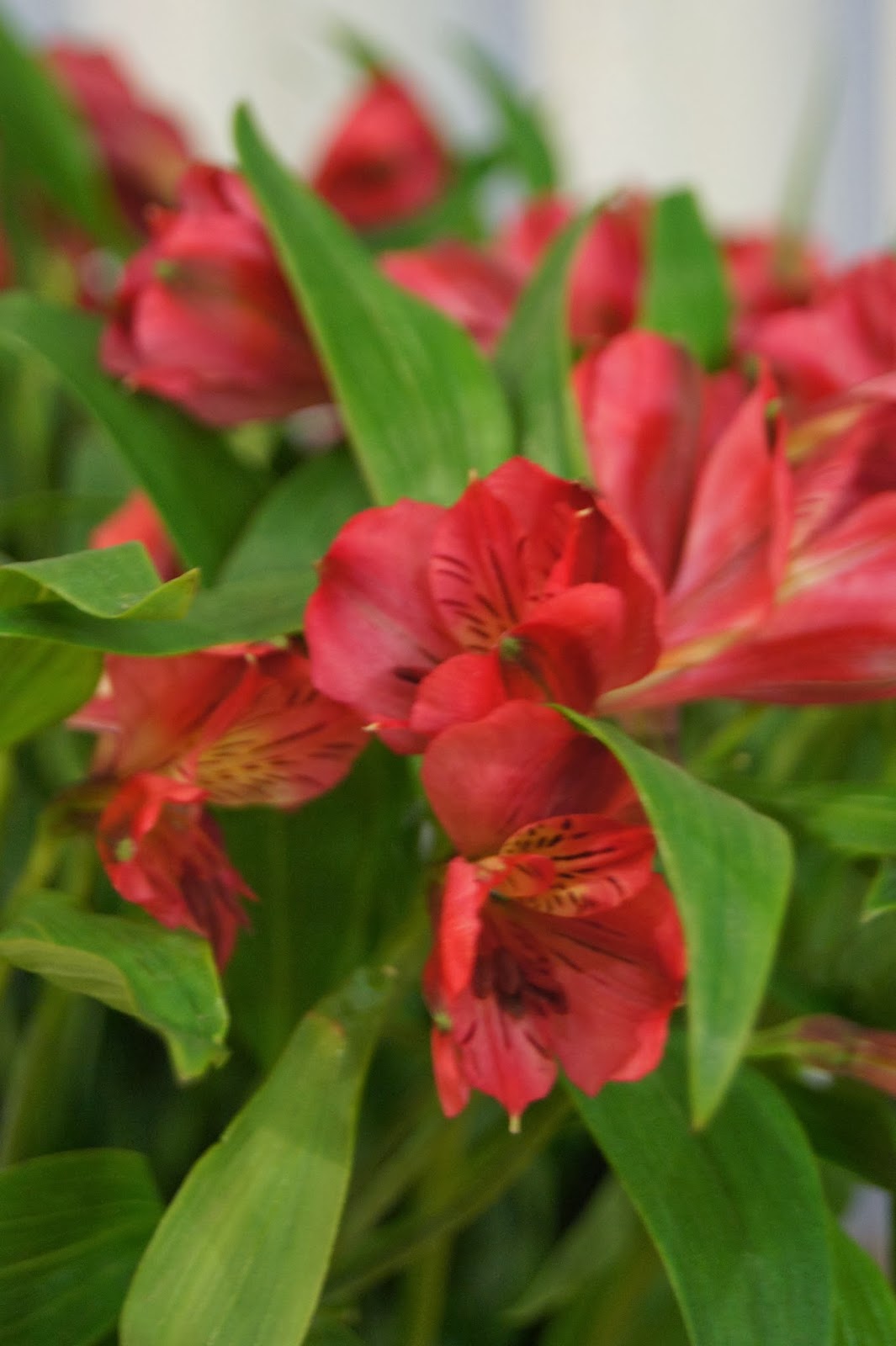
Look at these beautiful roses – they were imported from Kenya and I bought them in Sainsbury’s for the first of my workshops based on supermarket flowers. Although I prefer to buy seasonal English flowers, in the winter months the choice becomes very limited and I turn to other sources, including supermarkets. The size of the cut flower and houseplant market in the UK is estimated by Mintel to be about £2.2 billion. It is further estimated that about 70% of UK cut flowers are sold through supermarkets. Research by the Garden Museum suggests that only 10% of all the flowers sold in the UK are grown in the UK – this is down from 50% in the 1980s. The large majority of flowers sold in supermarkets are imported from Holland, Kenya and Columbia. In practice, many of the flowers coming through the Dutch flower market are imported into Holland from developing countries. These bright red alstroemeria were imported from Columbia.

Should we be worried about this? Of course we should. We are in danger of losing our British flower growing industry completely and our high street florists are in serious decline. This is mainly because supermarket flowers are ridiculously cheap. They are cheap because most of them have been grown in developing countries where growing costs are less than in the UK (the climate is hotter and the labour costs are rock bottom low) and also because of the supermarkets’ buying power which drives growers’ prices down. However, there are a number of ethical challenges associated with flowers imported from developing countries. A War on Want Report, ‘The human cost of cut flowers in British supermarkets’, published in 2007 provided evidence of very poor working conditions for flower workers (largely women) in Columbia and Kenya – these included very low pay, exposure to toxic chemicals, repetitive strain injuries, forced labour and job insecurity. Concerns were also raised about the use of huge amounts of water to cultivate flowers at the expense of small-scale farmers growing other crops. These concerns are supported by a number of recent academic papers about the cut flower industry in a range of developing countries. For example:
I am pleased to say that we can all do something about this by buying flowers certified by the Fair Trade Foundation. This is an independent, non-profitmaking organisation which licenses the use of the fair trade mark in accordance with international standards. It states ‘Our vision is of a world in which justice and sustainable development are at the heart of trade structures and practices so that everyone, through their work, can maintain a decent and dignified livelihood and develop their full potential.’ It works to achieve better prices, decent working conditions, local sustainability and fair trade for farmers and workers in the developing world. When flower farmers achieve fair trade certification they commit to implementing better pay and working conditions and to farming in a more sustainable and safer way. When you buy fair trade flowers you pay an extra 10% (the fair trade premium) for your flowers and this goes back to the flower workers for projects to support them and their communities. All the roses pictured here and used in my workshops were sourced from fair trade farms and if you look on the flower packaging it will tell you exactly where the flowers came from. If you then look on Sainsbury’s website you can link up with the Fair Trade Foundation to find out what the fair trade premium (10% of the cost of the flowers) achieved for the flower workers (things like schools, vaccinations, clinics and water purification). For example:
I decided to concentrate on using fair trade roses for my two workshops. First of all we made a contemporary arrangement in small square boxes. I made these by covering juice cartons with pretty vintage paper. For the Christmas workshop I used a Christmassy vintage paper. Here are the boxes.

And here are the arrangements – they work well either spread out (pretty with tea lights set in between the boxes) or pushed together into a block to make an impact.

We also made a simple, but effective arrangement of three roses in a pretty glass bottle. We used Belvoir cordial bottles for this – they have a vintage look about them with the name Belvoir pressed into the glass. These look great if you place three in a row along a window sill or a mantelpiece.

Then we made a wilder arrangement in a glass jug using fair trade roses, alstroemeria and seasonal foliage. Supermarkets sell hardly any foliage (and if they do it is tremendously expensive) so we used foliage gathered from around my house. For the first workshop we used holly, ivy and yew (be careful with yew as it is very poisonous!).

We also used white English alstroemeria from Cornwall (to go with the pink roses). I was delighted to find that Sainsbury’s was selling this when I went flower shopping (though they didn`t have it when I went shopping for the second workshop). Again, the packaging was very informative and provided details of the grower and his farm – the flowers were super fresh and very lovely. Another hit for Sainsbury’s as far as I am concerned. So here is something else we can all do – buy British flowers whenever they are available.

For the second workshop we used the bright red alstroemeria from Columbia with white roses. The foliage was ivy, holly and pine (including few pine cones…..very Christmassy). Here are some pictures from both of the workshops:

And here are some of the workshop participants – all looking very pleased with their beautiful arrangements.

I would like to finish this blog on an up-beat note. There has been a lot of interest in British flowers recently and many people are beginning to see what growing in our own country has to offer. Last spring (2013) the Garden Museum in London ran an exhibition with the title of Floriculture – Flowers, Love and Money. This included ‘a celebration of domestic growers, an industry which has all but vanished but may be revived by a new generation of eco-aware creative growers’. Then New Covent Garden ran a British Flowers Week in June last year – this featured British peonies, delphiniums, sweet peas, stocks and foliage (see my blog of June 2013, including my own contribution to the week). More recently my wholesaler in Cornwall – James at Flowers by Clowance – reported that the current BBC series on the Great British Garden Revival has led to an increase in orders for English flowers. Fantastic. He also told his customers about the Great Flower Farmers’ Meet Up in Devon a couple of weeks ago. 100 British flower growers met together for what sounds like informative sessions about developing businesses, mutual support and a lot of fun. This makes me feel more optimistic about the future of the industry. Finally, as a contrast to the Kenyan roses, here is a picture to remind you of what a spring bouquet made with only English flowers and foliage looks like – soft, fragrant and colourful. Simply lovely.

So, my challenge to you all is to buy British flowers and Fair Trade flowers whenever you can. As consumers we have a lot of power if we act together and we can make a real difference to the lives of flower farmers here in the UK and also around the world.

Sunday, 1 December 2013

Christmas flowers: bouquets and workshops

As December begins everyone is gearing up for Christmas, including me. I`ve decided to use this blog to tell you about my Christmas flower offers. I have just bought some lovely Heron Cross jugs with festive designs on them and I spent this morning designing and making different bouquets to place in them. Earlier in the week I had a delivery of flowers and foliage from Cornwall – the type of thing I expect to be available for Christmas – fragrant narcissi (white and yellow), white and red alstroemeria, anemones, pittosporum and two sorts of eucalyptus. I added white and red roses and hypericum berries from Sheffield flower market to the mix. The first arrangement was made for a red and white jug decorated with poinsettias and white hellebores (the one pictured above). What could be more Christmassy!
These close up pictures show the beauty of the flowers:

Then I made a bouquet with a warmer feel to it (bringing in the yellow narcissi) for a jug pattern based on autumnal fruits.
Here is the vibrant detail:

For a striking contrast I made a cool bouquet using only white and green which looked very elegant in this jug with an ivy pattern on it.

What lovely white flowers:

If you would like to order your Christmas flowers from me, the special Christmas prices are as follows:

Bouquet in a jug (including the price of the jug which retails at £20): £40
Bouquet wrapped in cellophane with water and packed in a Meadowsweet box: £30

I have a limited number of each of the three jug designs and will sell them on a first come, first served basis. I have to get my order in to Cornwall as soon as possible (there will be a huge demand for fresh flowers in the run up to Christmas) and the deadline for ordering flowers from me is Tuesday 10 December (so please hurry).

My Christmas flower workshop on Monday 23 December is all full up, but I do have places available for the workshop on Saturday 21 December. This workshop will be to make a hand-tied bouquet (rather like the ones above) and present it in one of the festive Heron Cross jugs. You will also get to make a small posy (to practice hand-tying) in a Christmassy jam jar. The cost of this is reduced to £40 and is really good value as you have a great experience, learn a new skill and take two lovely arrangements away. Please get in touch as soon as possible to book a place (phone 0114 2363634, mobile 07717 757565, email liz@meadowsweetflowers.com).

I am now introducing Christmas gift vouchers for Meadowsweet flower workshops in 2014. You can buy a voucher for £45 and the person receiving it will be able to attend any of my 2014 workshops next year (subject to availability of course). What a great (and unusual) Christmas present for someone who loves flowers. Please contact me for more details.

Tuesday, 1 October 2013

Mists and mellow fruitfulness

Autumn has made a colourful start this year. This is the view from our back door in mid-September. The flowers still in full bloom include scabious, cornflowers, phlox, astrantia (second flush), anemones, lavender, verbena, geraniums and cosmos. You can also see the berries starting to turn red on the cotoneaster tree, the last of the beans and the enormous broccoli plants Mike planted – they have an architectural look to them and I hope they will produce something to eat in due course.

I ran two workshops in September using seasonal English flowers. The first was on a Saturday morning – bright and warm. The picture above shows the room set up. The flowers in the jug are blue ageratum, asters (China asters) and astrantia. You can just see some of the flowers and foliage in the buckets – beautiful tall delphiniums, ever-lovely alstroemeria, proud up-standing liatris and really pretty small white asters (September flowers). Then there is the mechanical stuff – wire, tape and containers. The plan was to make a round table centre in a bowl covered with aspidistra leaves and finished off with a band of raffia. It is amazing just how many flowers can be fitted into the container. The participants were a group of friends/sisters and here they are at the end of the workshop with their wonderful, arresting arrangements. And a glass of celebratory wine in hand!

And here is a close-up of one of the arrangements in all its splendour.

One of the great advantages of arrangements made in chicken wire (as opposed to oasis) is that dead flowers can be taken out and new flowers slotted in to perk up the arrangements. One of the participants wrote to me two weeks after the workshop to say ‘with a few adjustments and replacements most of them are still going’. It was excellent to hear this and to have yet more evidence to support the case for chicken wire and against oasis!

The next workshop was on a Thursday evening after work and it was made up of people who work at Sheffield Hallam University. They all seem to find the flower workshops therapeutic and relaxing after a hard day at the chalk face (or in frustrating meetings). This picture shows the room set up from a different angle.

This workshop had a different theme. The plan was to make a large hand-tied bouquet and present it in a lovely Heron Cross jug with an autumnal pattern on it. But because it is quite hard to make a hand-tied bouquet we practiced first by making a small posy and presenting it in a jam jar. We used similar flowers as in the previous workshop with just a few differences. Instead of liatris we had some gorgeous deep purple snap dragons to add height to the bouquet.  We also added in interesting foliage – rosemary, eucalyptus and ruscus – and some pretty carnations (a mix of deep purple and white). For the small posies I also used some flowers from our garden – purple verbena bonariensis, white snapdragons and white garlic chive flowers. Then the crowning glory was the addition of exquisite red kaffir lilies around the edge of the posy and the bouquet (these are only available for a couple of weeks or so in the Autumn).  When constructing the bouquet, I encouraged everyone to set up all their flowers and foliage in the order in which they would be used, working from left to right – like this:

As you can see the night drew in as the workshop progressed and by the end we were in artificial light. Here are some pictures of the finished arrangements. If you look at the flowers in the jam jars you can see what a good job the participants made of creating a spiral - the essence of the hand-tied arrangement. The riot of colour has been created by the number of arrangements on the table (8 in all), the pattern on the jugs and other arrangements in the background. Gorgeous.

Then to finish off this blog here are a few additional arrangements I made in September that have something in common with the workshop themes. First, there is a different arrangement in the Heron Cross jug:

Then there is another round arrangement in wire. In this one I used fatsia leaves from the garden to cover the bowl – I like the way the veins on the leaves look a bit like a sunrise.

And finally, here is a large arrangement I made in chicken wire and placed in an old Victorian urn. Whilst the urn is not particularly pretty, I do think it is rather handsome and that it works very well with tall blue flowers like delphiniums.



Monday, 19 August 2013

Pies, pickles and and flowers for St Lukes

Our friend Hazel is a trustee of St Lukes – the Sheffield Hospice. St Lukes is greatly loved and supported in Sheffield. It has provided palliative care to thousands and thousands of people and fantastic support to families. It is currently running an appeal to build a new in-patient section to the hospice and to refurbish the existing structure. The appeal target is £5.5 million and £4 million has already been raised. As part of the push to raise the last £1.5 million, Hazel organised a ‘pie and pickles’ lunch. She worked really hard to organise the event and to use her powers of persuasion to get everything donated – the pies, pickles, salads, pizzas, fizz, wine, beer, strawberries, the entertainment and, of course, the flowers!

I made arrangements in jam jars for the tables and decorated them with pretty vintage paper. I also made two large arrangements in jugs.

I used flowers from Cornwall and I also added in some flowers and foliage from our garden – our hydrangeas, snapdragons and scabious were particularly lovely. I made 12 jam jars and here they are ready to go on our kitchen table.

The lunch took place in Baslow village hall on a sunny Saturday in early August. When I arrived at the hall with the flowers it was a hive of activity – in the kitchen, setting out glasses and wine and getting the raffle ready. The tables had been set with blue table cloths, cutlery, place settings with a quiz and paperwork for making donations. The vintage paper I used for the jam jars was mainly blue and matched the blue table cloths. The flowers helped to bring the hall to life. Here are a few examples of the flowers in place. I have tried to capture the ‘feel’ of the room.

The idea of the tags on the jars and jugs was that lunch guests would be encouraged to write their name on a tag if they would like to take the arrangement home…..then they would make a donation for it.

When the guests arrived they were welcomed with a glass of bubbly. Over 80 people attended and they were treated to good food and lots of wine. No wonder they looked as though they were having a great time! Here are a couple of pictures with people in them. They include a picture of my Dad (last picture) who came along with me to the lunch. He has just moved to Sheffield and he helped me with some of the flower preparation. I am threatening to train him up to be a flower arranging assistant!

As well as having a fabulous time, people were also very generous and the event raised £2,600 pounds. Fantastic! All of the flowers were tagged and taken home. I was very pleased that they made a contribution to the success of the event - both in terms of adding to the ambience of the occasion and in raising extra donations. Flowers just make me want to smile….I hope they have the same effect on you.