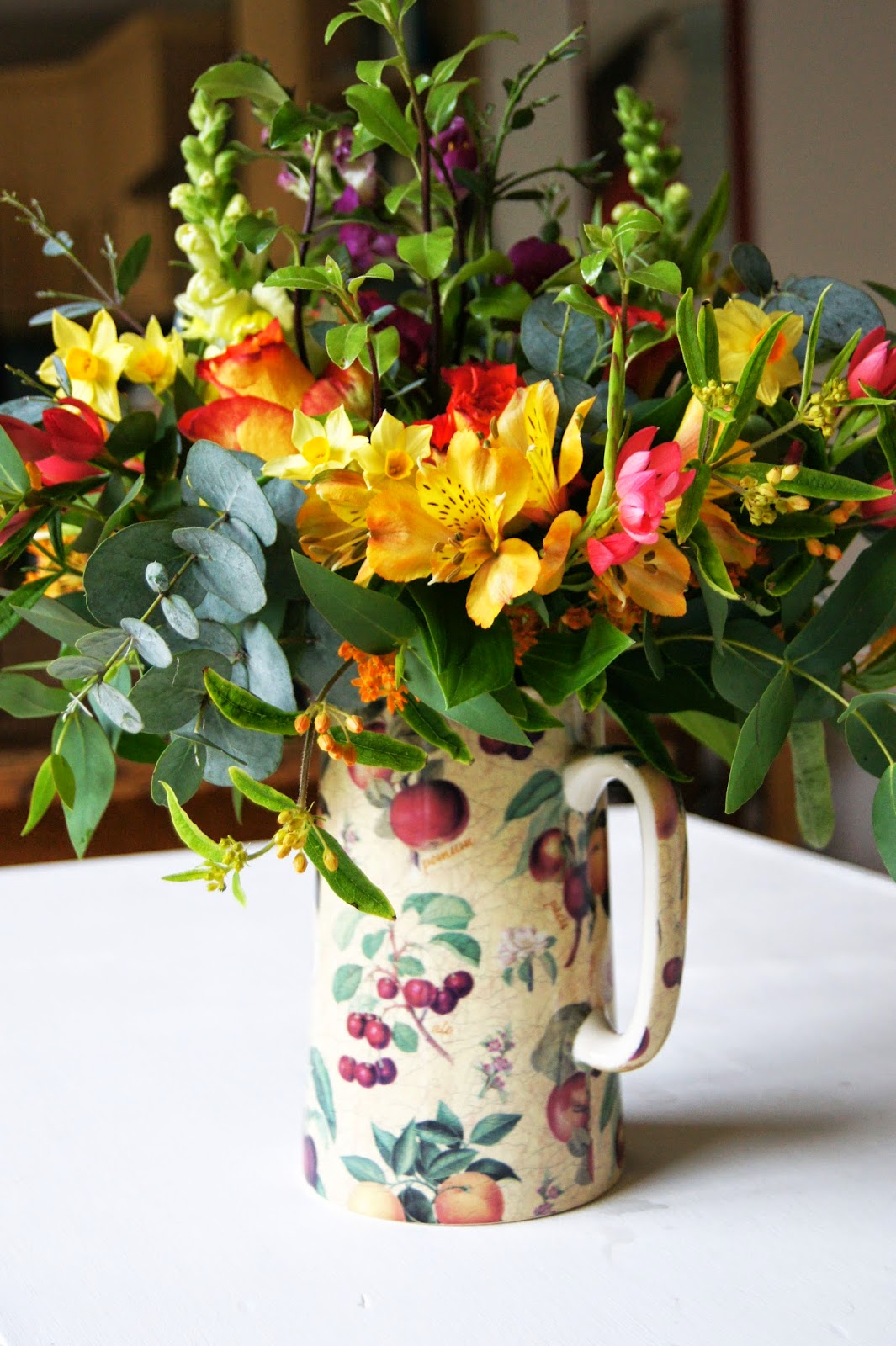
Wednesday, 11 February 2015

South West Flower Growers

Last week I went down to Devon to the annual meeting of the South West British Flower Growers. We stayed with our friends in Exeter the night before the meeting and I gave them a present of a few English spring flowers (hyacinths and anemones) mixed up with several different types of foliage from our garden. I hand-tied the flowers and placed them in this pretty Heron Cross jug. This is the jug we will use for the flower workshop on Saturday 14 March – lovely for Mother’s Day or just for yourself!  I went along to the meeting of the SW growers because there were some interesting talks and flower arranging demonstrations, and it was a chance to meet James from Clowance Flowers who is my main supplier. The meeting was thronged with excited growers and florists who specialise in using seasonal British flowers.

Several wholesalers had stands – growers, seed suppliers, packaging suppliers and more. Here are some pictures from the Clowance stand – an abundance of lovely English flowers (and a good example of the kind of flowers we will be using at the workshop in March).

The flower arranging demonstrations were done by the Academy of Floral Art which is based in Exeter. They run a mix of accredited floristry courses leading to qualifications and short courses aimed at florists and flower arrangers.

I liked the way they picked up the natural ethos of the growers and demonstrated arrangements made without floral foam. They used fallen twigs to create structures to hold seasonal English flowers in place, creating some impressive arrangements.

There was also a hand-tied arrangement in a large tin. I have used tins myself quite a lot, but I think they look a bit industrial – great for some commercial premises like restaurants or delis, but not so good for a softer domestic environment. I liked the touch of adding a bird and nest to the pussy willow.

The finale was the creation of a large arrangement in a heart shape. A wire structure covered with moss was used for the framework, then tulips sitting in plastic test tubes were tied in. This used surprisingly little flower material, but created great impact. All in all, some good ideas which I will have a go at modifying for my own purposes.

I was also really pleased to meet Georgie Newbery who is an energetic flower grower and entrepreneur. She runs a very successful flower farm in Somerset called Common Farm. She grows gorgeous flowers, does wedding and event flowers, sends bouquets through the post and runs lots of workshops. She has grown her business over the last few years and now employs several people – hats off to her! She has also just written an inspiring and practical book called ‘The Flower Farmer’s Year’ which I bought from her. It has already given me some good ideas and helpful tips as I plan my seed planting for 2015.

On the subject of books, I am on the look out for books by Constance Spry. She really was a front-runner of modern floristry ideas and I am going to write a blog about her later this year. So far, I have found this book with the great title of ‘How to Do the Flowers’.

Spring seemed quite a lot further on in Devon than Sheffield, but when we got back I found a clump of snowdrops poking through the snow in our back garden. Just a little sign that Spring in on its way…….


Saturday, 3 January 2015

Christmas reflections

It has been a fantastic flowery Christmas this year. I can`t quite believe how many flowers and how much foliage has been used to make so many gorgeous arrangements. I ran two workshops in very different settings to make a Christmas table centre. This involved decorating a cube-shaped vase with dried materials and then filling it with fresh flowers and foliage. The first workshop was in the usual place for the usual number of people (just 4). These are the materials we used to decorate the vase.

First of all we made a foliage structure inside the vase with eucalyptus, pittosporum, ivy, spruce and holly. Then we added the red flowers and berries into the structure – alstroemeria, anemones, hypericum berries, lucadendron and luscious grand prix roses. As a last touch we added a bit of bling – gold wire with shiny beads attached.

Then we made 6 flowery table settings to match – some participants said they planned to hang them from their Christmas trees – what an excellent idea!

Here is the arrangement boxed up and ready to go, together with a few extras – some narcissi and mistletoe….and, of course, a glass of celebratory wine.

The second workshop took broadly the same approach, but it was for 18 ladies and it was held at the golf club. It was quite a logistical challenge to acquire the large quantities of foliage and flowers we needed - I sourced them from the flower market, supermarkets and some foraging from gardens. The evening was great fun and the arrangements looked fabulous, especially once they were packaged up in the Christmassy red bags I had found.

My other Christmas workshop was to make a traditional wreath. We started by making a straw base on a wire frame and then we added foliage to it. Here is the room ready to go.

The foliage (holly, ivy and spruce) was made into small bunches before it was bound into the frame.

Then we decorated the wreath with dried seed pods, pine cones, oranges, chillies, hydrangea heads and a tartan bow. The wreaths were quite challenging to make, but all the effort was well rewarded as they looked wonderful when they were finished. Here are two participants holding their wreaths up high – you can just see their eyes peering through the hole in the middle if you look carefully.

Hanging wreaths can be a bit of a challenge. I chose to use the two wreath method – two identical wreaths are attached using ribbon and hung on each side of the door. The weight of the wreaths holds them in place and, hey presto, no need for any nails, screws or hanging devices!

A small wreath with a candle in the middle looks great as a table centre. Here is a really simple idea I have taken from my last supermarket workshop.  All you need to do is set 5 shot glasses on a circular mirror, place roses in the glasses and then add in a few Christmas materials – for example cones, chestnuts and dried chillies. At night with the candle lit, light is reflected by the mirror and the arrangement looks pretty impressive…..and so very easy.

Most of us are really busy in the run up to Christmas and if you don`t manage to come to a flower workshop you probably just buy some flowers from the supermarket and pop them into a vase. We made an arrangement in just this way at the supermarket flowers workshop. I chose festive colours and used a Tesco’s mixed bouquet together with a few extra roses and alstroemeria. Again, easy to make and easy on the eye.

I decided to use a non-traditional colour scheme for my Christmas vases this year. I chose vintage jugs which are decorated with a predominantly blue pattern and I used all the primary colours in the arrangements – red and blue anemones, red berries and yellow narcissi. In another jug I used white narcissi instead. I was pleased with them all.

As I settled in for the Christmas holiday I felt very warm inside as I thought about all the work I have done with flowers during 2014. As we come to the end of this festive period, I would like to thank you all for supporting Meadowsweet and wish you a very happy and peaceful New Year. 


Wednesday, 5 November 2014

Halloween

It’s all orange, red, yellow and black at the moment. We are surrounded by autumnal leaves, witches hats, pumpkins and fireworks. I wanted to capture something of this for my Halloween workshop last week. So I painted these jam jars. The Cornish flowers we used were alstroemeria in red and orange, yellow narcissi, yellow and red snapdragons and exquisite red kaffir lilies. We also had three different sorts of Cornish foliage to work with and I added in a few orange roses and bright orange asclepias (the fluffy orange flowers you can see below) from Sheffield flower market. Here are the flowers ready to go:

And here are the jugs and jam jars we used.

The main arrangement was a large bouquet presented in an autumnal Heron Cross jug. Here it is on the night of the workshop, and again in the daylight.

I can`t resist including this picture of one of the workshop participants – I love the way she is smiling whilst surrounded with so many flowers.

As an alternative to the Halloween painted jam jars, I decorated some with pretty vintage paper depicting all sorts of pumpkins, gourds and squashes - a more muted look than the bright orange jars.

Then, having used the alternative jam jars for flowers, I put candles in the Halloween jam jars and placed them in our porch to welcome our ‘trick or treat’ visitors who came to our door on 31st October.

My next flower workshop is on Saturday 22 November when we will be making arrangements in vintage containers. Here is a taster of the kind of thing we will make in cups and saucers and sundae dishes:


Thursday, 16 October 2014

Colour

Here are the three primary colours – red, blue and yellow. I have been thinking about colour a lot this summer. It all started on holiday in St Ives when we were surrounded by vibrant summer colours – deep blue sea and sky, yellow sand and multi-coloured seaside paraphernalia – things like umbrellas, bikinis and beach towels. Also we visited the Tate Gallery and I bought a book about an artist called Winifred Nicholson called ‘Music of Colour’. Winifred painted from the 1920s through to the 1970s and she painted flowers a lot. She also wrote about colour: 

'Flowers create colours out of the light of the sun, refracted by the rainbow prism. So I paint flowers……The flowers are sparks of light, built of and thrown out into the air as rainbows are thrown, in an arc.’ 

This is the heart of it – the perception of colour is created by the reflection of light received by our eyes. The full range of colours can be seen in rainbows. Books about art and photography usually depict the relationship between different colours in the shape of a circle – often called the colour wheel.  I have shown it here with small jars of flowers.

The circle shows how new colours are mixed from the three primary colours. When creating flower arrangements colours can be used in many different ways. I like to work with analogous colours – these are colours which lie next to each other on the colour wheel – like these yellows and oranges (I am including some green here as well because I generally add some foliage to my arrangements and I see it as being neutral in flower arrangements).

Yellows, reds and oranges are called ‘warm’ or even ‘hot’ colours, not just because we associate them with sun, heat and fire but because they are vivid and energetic and they seem to advance towards us when we look at them . Here are some examples of arrangements using these colours. The flat arrangement below is a funeral sheaf, but these bright colours celebrate a life well lived rather than a sad loss.

My favourite colours are the analogous colours that reside around blue – blue itself, blue-violet, red-violet and even a bit of red or pink (but no yellow, except perhaps the centre of a daisy or a cosmos bloom).

My portfolio is full of arrangements using these colours. Here are some bridesmaids posies and flowers for a wedding reception.

And here are some examples from just a few days ago when I was demonstrating a couple of ways of making arrangements (hand-tying and using chicken wire) to a group of ladies from WIs in the Peak District.

Complementary colour schemes use two colours that lie approximately opposite each other on the colour wheel. For example, blue and orange. This is an unusual, but really effective combination. The arrangement in the blue jug is made from fair trade roses and clary sage which I grew very successfully in our garden this year (oh...and there are a few of our Sheffield-grown apricots!)..

Or, yellow and violet. This is a combination that I really like. The arrangement below is made from fair trade roses and flowers from our garden - verbena bonariensis, sweet peas and self set fennel.

The high contrast of complementary colours is exciting to the eye and more striking than analogous colours. But often I want to create a more muted, gentler effect. Black, grey and white are achromatic (without colour) and they all work in a neutral way with flowers to set off or enhance colour. This can be in the form of vases, or as white flowers which lighten the impact of an arrangement. I tend to use a lot of white in wedding arrangements, like this bridal bouquet.

The wedding circlet below used muted colours – light pink sweet william, grey-blue lavender and sea holly and white avalanche roses. It was placed against a neutral grey wall and I think the whole effect is really lovely – soft and romantic.

I will finish with a wonderful burst of colour. It was my birthday last month and I was given this exuberant arrangement by Aunty Joan. I placed it on top of a table runner which I had put in place for my party. It just happened to use the same colours as Joan’s arrangement.  I had made simple jam jar arrangements in white and green – the colour in Joan’s arrangement brought these to zingy life. What a fantastic birthday present!