Monday, 28 May 2012

Blossoming, Blooming, Burgeoning Spring

I am writing this in May – just as the last tulips and bluebells finish and the cosmos (white and pink) are starting to flower. It has been a strange Spring with days as hot as July in March followed by bitterly cold weather all through April and most of May. But just look at this gorgeous bleeding heart (dicentra) that is growing in our front garden. It seems to really like the place it has settled into. Such pretty, fairy-tale flowers. And here they are in a Kilner Jar together with tulips, veronica, delphiniums, alstroemeria and stocks (some of it from the flower market in Sheffield).
Our garden has produced some wonderful flowers through the Spring – bluebells (both sorts – English and Spanish), daffodils, tulips (a fantastic range of colours – pink, deep purple, bright orange, white and red), snakes head fritillary, gorgeous vibernum (the blossoms start off lime and then turn into frothy white balls), berberis (with little pink, delicate flowers), camellia, sweet rocket and self-set aquilegia. Here is just a small taste of it:
In April we visited a new antique shop in Sheffield with our friends Angela and Ianthe who were staying with us. I found a lovely rose bowl made out of ‘vaseline glass’. This is a really pretty green colour and it is called ‘vaseline glass’ because it looks like petroleum jelly. It is made by adding uranium to the glass! It probably dates from the early part of the twentieth century. It has a removable grid on the top (I think it’s very attractive) to hold the flowers in place. Here is my first attempt at making an arrangement in it – everything was picked from the garden on a lovely day in late April.
I have been making a few commissioned bouquets over the last few weeks. I used English flowers from my wholesaler. The lilies were especially gorgeous – a dusky pink and without an over-powering smell. I also really liked the narcissi, the pink tulips and the anemones. I used similar flowers for my stall at the Nether Edge Farmers’ Market in March. Here are some examples of what I did with them:
Later this year I am arranging the flowers for a couple of weddings – for Jessie’s friend Lisa and for Mike’s god-daughter Eleanor. I will be doing table arrangements, bouquets and button - holes. This made me think about how to gear up to make multiple arrangements (for up to 14 tables say). One idea I had was to use the pretty jugs produced by the Heron Cross Pottery in Stoke-on-Trent. I love this business. The pottery was built in 1876 and has operated since then apart for a period during the Second World War when it was requisitioned for storage. It is still a family run business and the pottery is made in the traditional way in a bottle kiln. The products are really pretty with a great range of chintzy patterns which suit the country look of my flowers very well. I bought half a dozen jugs in two different colours and patterns – this gives a flavour of what they might look like when several are used together.
I sold some of my flowers in these jugs at the Farmers’ Market – people really seemed to like them and I will be selling them again at the next market in June. I am also building up a collection of vintage jugs and vases. These would create a different sort of feel – more quirky and eclectic. As I am moving into events now, I thought it would be a good idea to get hold of a pair of large vases with a narrow neck. My idea was to make really big arrangements for a church or a venue without floral foam. In practice I found it very hard to find anything that met my requirements. In the end I had a couple of vases made for me by the Brook Street Pottery in Hay-On-Wye. They are about 14 inches high and made out of terracotta with a pale sandy coloured slip on the outside. I have only just started to experiment with them. Here is the pair filled with simple plum blossom, and one with an arrangement in it. I will be doing more with these later in the year.
Mike and I have just finished planting out new flowers for the summer. We have grown lots of things from seed – sunflowers, corn flowers, ammi, sweet peas, scabious, bells of Ireland, antirrhinums, cosmos and meadowsweet. We have also bought some perennial plants – veronica, astrantia, phlox, delphiniums, lady’s mantle (alchemilla), baby's breath (gypsophila), verbena and echinacea. So there is lots to look forward to over the coming months – both seeing these flowers develop and working on ideas for wedding flowers. I will be back again soon with summer flower news from Sheffield.

Thursday, 8 March 2012

Cold days and a sniff of spring


The dark days of winter are not the best of times for working with flowers. But they have given me some time for experimenting, especially for finding ways of arranging flowers without floral foam. This first arrangement has been made using chicken wire to hold the flowers in place. I was pleased with the way it worked. The flowers stayed in position really well and there were some advantages over foam – it was easy to take out a flower and re-arrange it (this isn`t a good idea with foam as too much re-arranging makes the foam disintegrate) and the flowers have access to far more water which means they last longer than they would in foam. I used bought flowers supplemented with foliage from our garden – juniper, eucalyptus, fatsia leaves and ivy – placed in an urn I acquired from my father’s house to make the arrangement. The urn is quite an ugly thing, but I think it has a kind of majesty.

Look at this ingenious idea for making my second experiment - a wreath shape without floral foam.


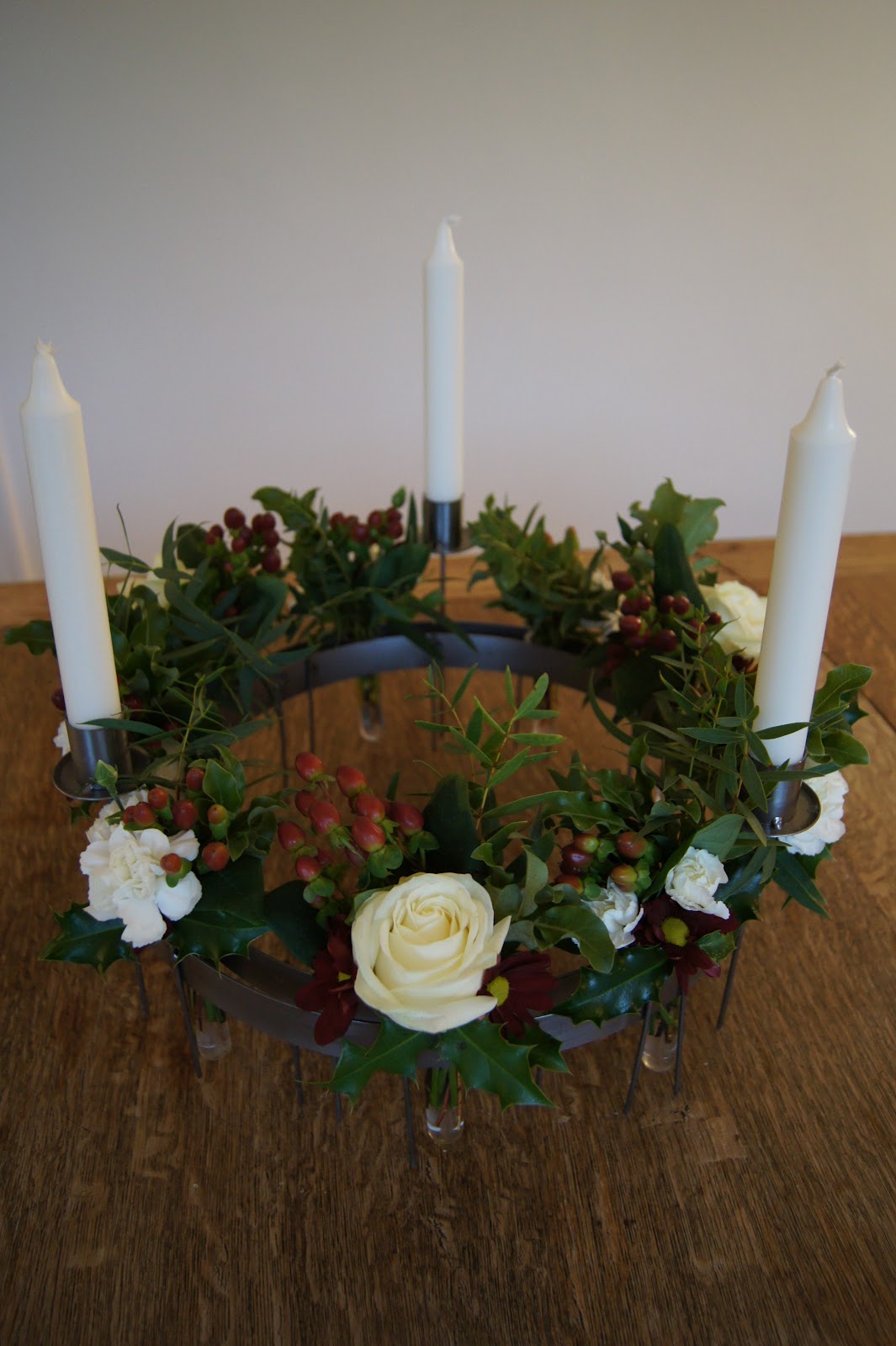
The flower design involved making little bunches of flowers and foliage that were placed in test tubes held in place in two concentric circles of metal. I used winter colours – white roses and carnations with deep burgundy chrysanthemums and hypericum berries. This made an attractive and quite dramatic table centre. The test tubes needed re-filling every day – but the flowers lasted well for at least a week.

Although we had some frosts in January, we had some gorgeous bright days too. There were a few flowering survivors from 2011 that lasted well into January, like these roses, pinks, antirrhinums and geraniums.


One of the best things we have in our garden in winter is sarcococca (also known as Christmas box). This is a wonderful shrub with deep green leaves and little white flowers which appear in January and February. They smell wonderful and really brighten up the winter.


Here is an arrangement using the sarcococca along with other foliage from our garden and some bought tulips, alstroemeria and roses. When buying flowers through the winter I have chosen English or fair trade flowers wherever possible. I used this vintage blue jug (I am building up my collection of vintage containers) which I think has a pleasing shape and colour.


As we moved into February, the first signs of spring began to appear. We have two sorts of crocus in our garden at the moment, a beautiful camellia, a robust hellebore, lovely primula (yellow and purple) and the daffodils started to appear at the end of February. Here is a flavour of it all:


Mike has been germinating seeds for me over the last month – different colours of scabious, corn flowers, cosmos (white and pink), small sunflowers, meadowsweet, white antirrhinums, ammi and moluccella (bells of Ireland). I hope these do well and that I will be making arrangements with them in the summer.

Lots and lots to look forward to in the coming months.

Wednesday, 21 December 2011

Christmas Markets


After the success of the Nether Edge Farmers’ Market in September, Ann and I were keen to take part in the Christmas Market in December. In fact, we were so geared up for Christmas that we decided to have a stall at the Sharrow Vale Market as well. Here we are all wrapped up against the elements – it was very cold and wet at both markets – but we are smiling! It was fantastic that lots of people turned out despite the weather – mostly they were on the hunt for Christmas presents, as well as soaking up the great market atmosphere along with the rain.

This time I made arrangements in seasonal colours – green, white and red. I got very excited when I found a grower/wholesaler of English flowers and foliage who could deliver flowers straight to our front door. I was able buy red/pink and white alstroemeria which were robust and proud and also parvifolia (the kind of eucalyptus with small leaves which I like best) and pittosporum, again with small leaves. It was a great surprise to find that English narcissi (wonderful scent) – both bright white and yellow – were available. I supplemented all of this with the last of the flowers from our garden – some lime green chrysanthemums, dark pink chrysanthemums, cotoneaster berries and even a few scabious. I also used some glossy green wild holly to add to the seasonal feel and some fatsia leaves from the garden. Then I added some gorgeous white avalanche roses and some white and red chrysanthemums which I bought from Sheffield Flower Market. Here are a few of the bouquets and bunches which I made.


The shoppers at the markets seem to like the posies in a jar very much. Often they say that they make great presents because the posy and the container come as a complete whole and they don`t have to worry whether the person they are giving it to has a vase at home which is the right size. I wanted to make Christmassy jars this time. My friend Ann (another Ann!) who lives in Oxford gave me the idea of gluing hand-made paper to jars. She had done this with old glasses to make tea-light containers and she said that the paper seemed very strong and even stood up to being left outside in the rain. I used green and red paper and painted over it with gold paint to add a bit of sparkle. Then I tied the jars with tartan ribbon. I was very pleased with the effect – I thought the jars looked bright and seasonal without being tacky. I sold nearly all of them – so quite a winner.


My other product was the completed pomanders. These looked and smelled lovely. Lots of people came to sniff them and some reminisced about making them when they were children. Again, I sold most of these, but I also kept a few back to give to friends and family as stocking fillers.


The farmers’ markets have been a great experience for me. They have given me an opportunity to buy flowers on a larger scale than just a home situation and I have learned a great deal about the flower supply chain and how to judge the amount of flowers and foliage needed to make a lot of arrangements. I have also offered my work to a buying public and talked to people about my values and approach. It is heartening that people like what I am doing and I feel encouraged to build on this.

We are now coming to the end of 2011 and during this year I have travelled a long way in my learning about how I want to work with flowers. I have lots of ideas I want to try out in 2012 and I am hoping to grow my business a little. Meadowsweet has made a great start and I am looking forward to the excitement and challenges of the next stage in its development.

Happy Christmas and a peaceful New Year to all my friends, family and readers.

Wednesday, 26 October 2011

Autumn in Sheffield


Our Sheffield garden has slipped from the dog days of summer into autumn.…but what a splendid autumn it is. We have had plenty of fine sunny days and are surrounded by leaves of gold, red and rust. We have also harvested wonderful crops of apples, chilli peppers and tomatoes – and we are still picking them in these last days of October. This first picture shows the garlic chives which have flowered in our garden for over two months now. You can also see the geraniums, sweet peas and calendula in the background, all of which are still in full flower.

I have been using the flowers we still have to create some autumnal arrangements. The picture below shows an arrangement using the last of the stocks and the pinks, with sweet peas, geraniums (someone told me that they don`t last in vases, but ours have done really well), scabious (just fantastic) and cotoneaster (so heavy with berries that the branches are nearly touching the ground). I have also used our eucalyptus and juniper as foliage. This is the first time I have used the pewter vase that I found in the French vide grenier this summer – I think it really suits warm autumnal arrangements, where it didn`t work so well with the light freshness of summer flowers (you can see apples from our trees in the background).


Mike gave me a macro lens for my camera for my birthday a few weeks ago. Just look what it can produce. These dark (nearly black) scabious are my absolute favourites at the moment.


In the spring this year we bought a selection of chrysanthemums at the RHS spring fair in Cardiff. All summer they only produced leaves and very long legs! But at last we are starting to see some blooms. This simple arrangement uses the first green flowers together with dark purple asters (gorgeous), scabious and garlic chives as a white contrast. I filled it out with foliage from our wall flowers (I hope it won`t impinge too much on next Spring's flowers!) and eucalyptus.


When we have our first frost (which must surely be soon) most of the remaining flowers will die. And as the nights draw in, my thoughts are moving to the arrangements I will make for Christmas. One thing I have decided to make is traditional pomanders. Essentially these are oranges cured with cloves and other spices. They were used in the sixteenth century to cover up the smells of an era without good washing facilities and sanitation!  Nowadays they just smell and look lovely – all citrus and spice which will be tied up with Christmassy ribbon. It takes six weeks to cure them – so I made a start yesterday. Here are the oranges with the cloves stuck into them. They are now sitting in bowls covered with ground spices where they will stay for the next few weeks. I will show you some more pictures of them when they are finished. In my next blog, I will have more ideas for Christmas.

Monday, 26 September 2011

Nether Edge Farmers Market


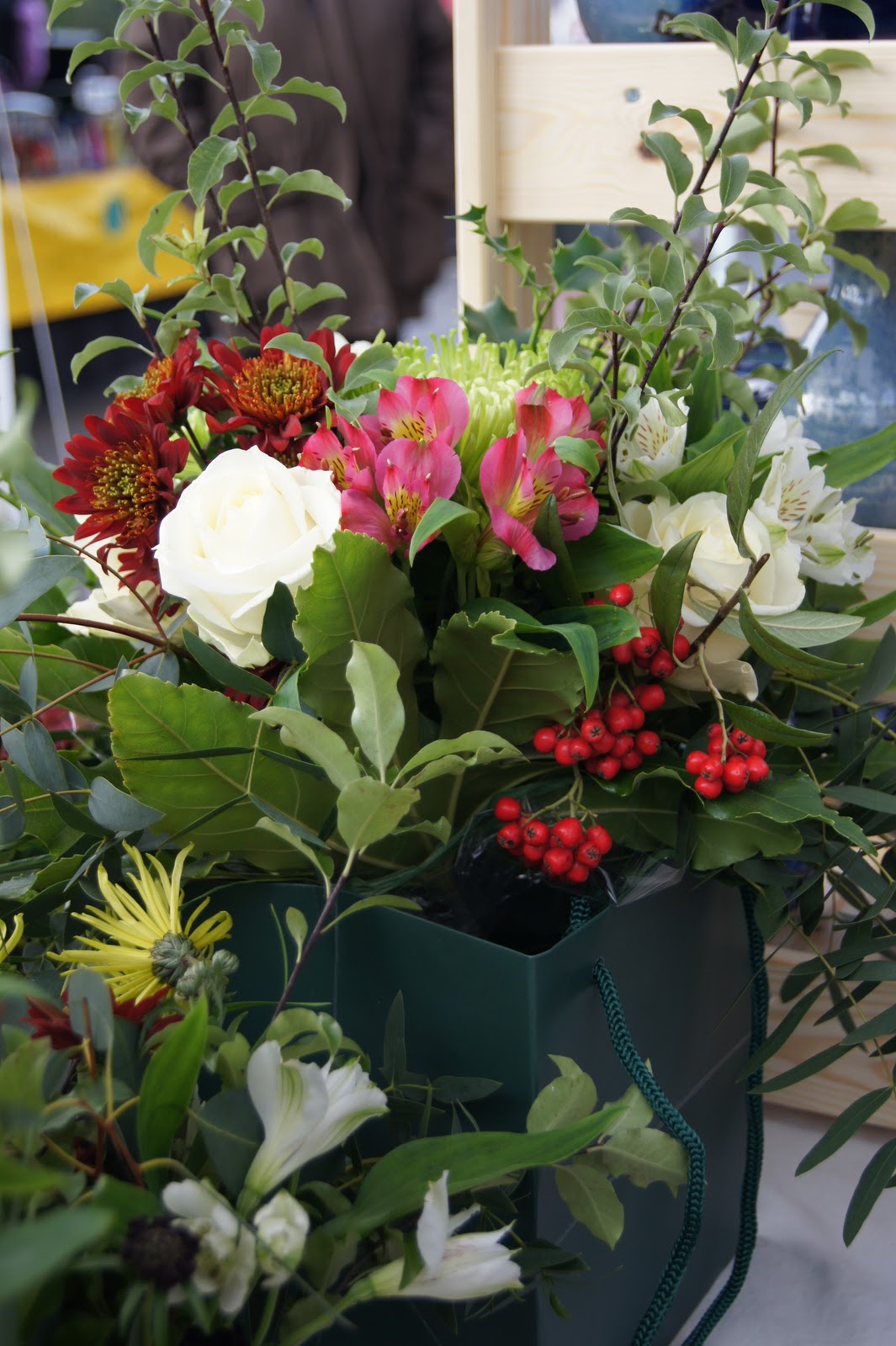
Here I am on the way to the Nether Edge Farmers’ Market in Sheffield. It took place yesterday, Sunday 25 September. I am carrying a crate of posies and a jug with a couple of bunches of flowers in it. Let me start by telling you about the arrangements that I created. All of these used flowers from English growers, together with some flowers and foliage from our own garden. I made a few large bouquets, using two different colour ways (I used broadly the same colours for all of the arrangements) and presented them in aqua packs in boxy green bags. These were the premium product! The first is based mostly on pinks/blues and purple, and the second is based on autumnal colours – mainly yellow and orange/brown.


Then I made several smaller hand-tied bunches which I finished off with a piece of pretty lace tied with some string. Here is one based on the yellow theme.


My main product was a range of small posies presented either in hand decorated jars or in up-cycled tins. I also made a few edible posies using borage and herbs from our garden. Here is an example of a posy in an up-cycled tin.


Then I had fantastic help from Jessie (my daughter) who designed the lettering for Meadowsweet and the little sprig of meadowsweet which sits alongside the name. She had special stamps made so that we could stamp the meadowsweet identity on to tags (which also acted as business cards) and bags of all sizes. I was really pleased with the way this simple method complemented the natural approach that I am taking to my work with flowers.


I shared the stall with my friend, Ann, who makes hand thrown ceramics – really lovely individual pieces in lots of different vibrant colours. The flowers and the ceramics really worked well together. Here we are at the start of the market behind our stall waiting for action to commence.


The whole market had a great vibe. It was full of interesting stalls – rustic bread, wild mushrooms, organic burgers, whole fresh trout, olives, cupcakes, crafts, plants and many more. It was at the centre of the Nether Edge community and was really well attended, even though the weather wasn`t great. Lots of people stopped to talk to us about our wares. They seemed to like my use of flowers – especially the focus on English flowers. They liked the pink/blue/purple colour way most and the best sellers were the posies in the hand decorated jars. This is a close up of some of the posies on the stall.


And here are Jessie and Anne later in the day with our stocks somewhat depleted. Anne and I were both pleased with the amount we sold and the positive response we received from the market customers.


The tags which Jessie made sat on the front of the stall. Many of these were picked up as people passed by and then dropped into handbags. They give details of how to contact me and what I am offering – market stalls, arrangements for parties and events and flower workshops. This was the first step in promoting my new business. It was a great experience overall and I am looking forward to running another stall in the run up to Christmas.

Tuesday, 13 September 2011

Flowers and the Environment

Flowers seem so natural that it is hard to think of them harming the environment. But they can. Transporting flowers from distant places like Kenya or Columbia, or even from Holland, generates carbon emissions. Also growers often use pesticides or fertilizers which are not regulated as tightly as they are for food production. This can be harmful to agricultural workers. The best flowers are those we grow in our own gardens with minimal use of chemicals – no ‘flower miles’ and safe for everyone’s health. If we don`t have our own garden flowers, I think it is best to buy responsibly grown flowers locally – like these lovely scabious and pure white chrysanthemums produced by British growers and bought in Sheffield flower market a few days ago .


It is possible to buy some British grown flowers on the high street now from Sainsburys, Marks and Spencers and other supermarkets, but so far I am finding it difficult to find a regular wholesale supplier of British flowers.

I am also increasingly worried about the use of floral foam (better known as Oasis) in flower arranging. This is potentially harmful to both the environment and florists. Most flower arrangers and florists use Oasis – the dry foam is soaked in water and then flower stems can be placed into it. The advantage of it is that it holds flowers in exactly the position you want them (even upside down) and it allows the flowers to drink water (but not as well as they do in a vase). So, this candelabra arrangement that I produced at Jane Packer’s Advanced Floral Design Course in June would be impossible to create without Oasis.


I have come across the website of a florist in Berkeley (her business is called Gorgeous and Green), USA, who has a personal mission to speak up about the risks associated with Oasis. She has directed interested people to the Material Safety Data Sheet (an official US document which lists all the health and safety issues related to products) for Oasis. She has pasted the 2009 version of the MSD Sheet onto her website. It states that Oasis is a thermoset plastic and it is not bio-degradable. It also states that it `may be irritating to eyes, skin and respiratory tract', that it 'may contain formaldehyde and/or carbon black' and that 'prolonged exposure may cause cancer'. Not good for florists or regular flower arrangers! Well I never liked it much anyway – nasty slimy stuff that looks very unattractive when it is time to deconstruct an arrangement. I have decided to avoid using it altogether and experiment with other ways of fixing flowers into place. One way is to use a container with a grid over the top which can hold the flowers. Here is an example using a small crystal bowl that I found at a Vide Grenier (get rid of stuff from your attic!) in France this summer.


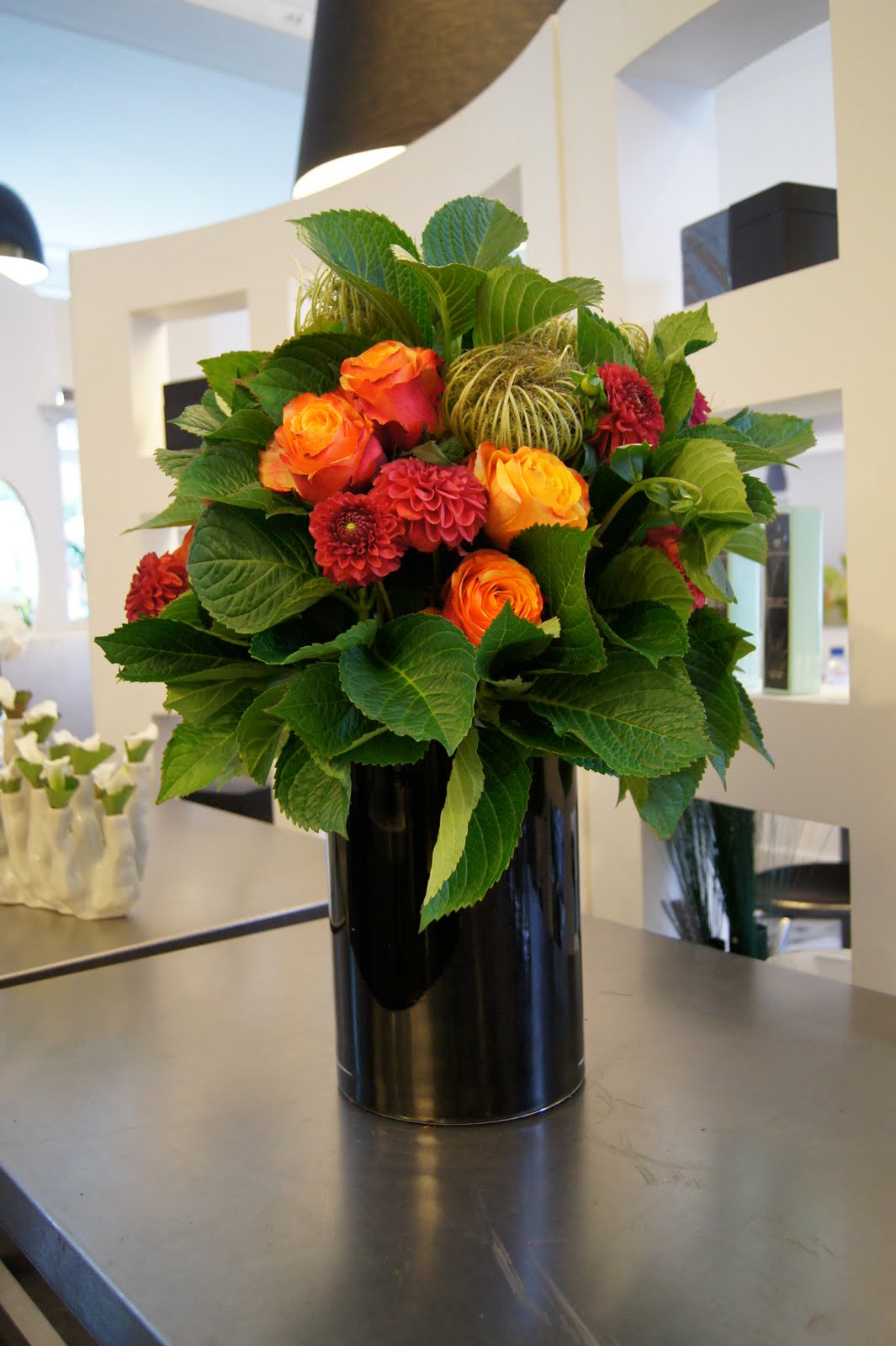
Here is another example where I made a grid out of tape (across the top of the vase) and made a large vibrant arrangement with bright orange roses, brown dahlias, dill seed heads and hydrangea leaves. I could not have made the flowers stand up properly without the grid, and the overall effect is just as good (and more natural in every sense) as it would have been with Oasis.


I have a book by Mary Rose Blacker called Flora Domestica – A History of Flower Arranging 1500-1930. This explains traditional ways which were used to hold flowers in place before floral foam was invented. I will be experimenting with these methods and reflecting on how they have worked in future blogs.